Gamora and the Infinity Stones
 August 9th, 2014 |
  Author:
 Guardians of the Galaxy
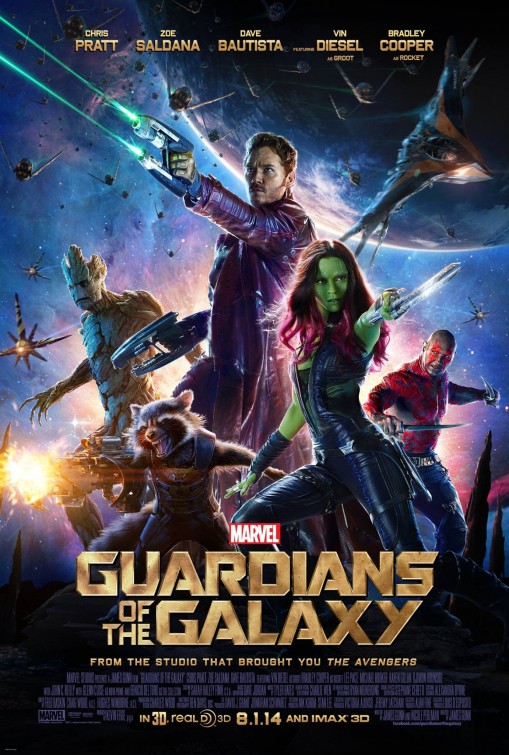
Director: James Gunn
Cast: Chris Pratt, Zoe Saldana, Michael Rooker, Glenn Close, Djimon Hounsou, Benicio del Toro, Lee Pace, Brad Cooper, Dave Bautista, John C. Reilly
Marvel’s sci fi action adventure Guardians of the Galaxy is like Star Wars on acid with an exceptionally cool soundtrack, featuring some 70’s and 80’s classics. Part comedy, part adventure, director James Gunn successfully mixes comic adventure with intergalactic chaos and mischief.
Featuring a suitably toned down Chris Pratt (Zero Dark Thirty) superbly cast as rebel Starlord, Peter Quinn who while rummaging on an abandoned planet discovers a mysterious orb which soon elicits a whole bunch of ragtag and riotious characters from all corners of the Galaxy as they race to claim the orb for themselves. The Guardians of the Galaxy featuring the amiable and funny Peter Quinn with some serious mommy issues, along with green skinned Gamora, played by Avatar star Zoe Saldana along with a talking racoon (yes you read that right) voiced by Bradley Cooper and a walking tree, with a severely limited vocabulary, voiced by Vin Diesel.
Guardians of the Galaxy is psychedelic sci-fi and not visionary like Elysium or Blade Runner, making no attempts to conceal its main target audience – teenage boys who have followed the comic book series of the same name. The film even retains a comic book feel and with some exceptionally interesting visual effects, Guardians certainly does make use of its 3D appeal.
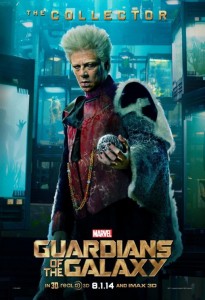
This is like Star Wars on LSD for a younger generation, but hugely enjoyable, thanks to the casting of comic actor Chris Pratt and Zoe Saldanha as Gamora, who are both after the powerful and illustrious infinity stones, which they soon hand over to the Collector, a wonderful cameo by Benicio del Toro, who was also seen in the closing credits of Thor: The Dark World.
Veteran actress Glenn Close (101 Dalmations) makes a camped up appearance as Prime Nova, a cipher of her Cruella de Ville character along with John C. Reilly and Djimon Hounsou of Blood Diamond fame.
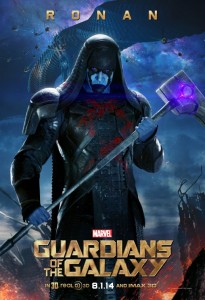
Lee Pace plays the evil Ronan who with his extraordinary makeup and pharaoh like costume is hellbent on destroying the Universe along with his adopted daughter Nebula played by Karen Gillian. Naturally the ragtag bunch of Guardians band together and fight the onslaught of the Kree against the fabulous planet Xander, which looks like Dubai on steroids.
Guardians of the Galaxy must have been a massive hit at San Diego’s Comicon and it’s not difficult to see why, humour mixed with romance, good versus evil all enveloped in a wildly over the top action adventure which makes the first Star Wars positively tame. Except that Star Wars was a classic and this sci-fi is not aiming to be anything more than merely fun and amusing much like the comics the story is based on. Marvel definitely got the concept right.
Recommended viewing for geek freaks and not to serious sci-fi fans, making Guardians definitely fall into the frivolous popcorn fodder category. Hugely enjoyable, with lots of implied moral messages, but this film does not aspire to be Alphonso Cuaron’s Gravity, this is Guardians of the Galaxy featuring Gamora and the infinity stones! Besides who can take this film seriously when there is a talking racoon and a tree in it?
 Posted in James Gunn, Marvel Cinema Universe |
  Tags: Benicio del Toro, Bradley Cooper, Chris Pratt, Dave Bautista, Djimon Hounsou, Glenn Close, John C. Reilly, Lee Pace, Michael Rooker, Vin Diesel, Zoe Saldana |
  Comments Closed
An Explosive Journey
The Hundred Year Old Man who
Climbed out the Window and Disappeared

Director: Felix Herngren
Cast: Robert Gustafsson, Georg Nikoloff, Cory Peterson, Kerry Shale, Alan Ford.
Definitely one of the highlights of DIFF 2014 http://www.durbanfilmfest.co.za/ was the film adaptation of the Swedish novel, The Hundred Year Old Man who Climbed out the Window and Disappeared. A hugely entertaining and entirely Scandinavian tale about a pyromaniac pensioner Alan Karlsson delightfully played by Robert Gustafsson who after blowing up a foxhole near his home in rural Sweden, is untimely placed in a seemingly secure retirement village.
On his hundredth birthday, Alan decides that this confinement is for the birds and literally climbs out the window and misses his hundredth birthday party. So begins a marvellous adventure in which Alan gets mistakenly mixed up with a gang of Neo-Nazi criminals, an elephant, an undecided student and a mischievous train station manager who are all after a suitcase filled with loads of cash.
Based on the internationally bestselling novel by Jonas Jonasson The 100 Year Old man is a delightful subtitled film as the audience follows the sweet natured Alan who whilst going on his escapades also reminisces about his life as an explosives expert, who happens to quite literally cross paths with some of the 20th century’s most ruthless dictators including Spain’s General Franco and Russia’s Stalin.
Through espionage and countless subterfuge, Alan also becomes involved with the Manhattan project about the building of the nuclear bomb by the Americans, gets drunk with President Franklin D. Roosevelt and even receives an invitation to the Atomic Energy Commission by the Swedish prime minister.
The 100 Year Old Man is truly a cinematic gem and a clever statement and parody on Sweden’s apparent neutrality throughout some of the last centuries most brutal, menacing and socially disruptive geo-political conflicts including the Spanish Civil War, World War II, the Cold War and even the 1968 counter-culture youth rebellion in Paris.
This is recommended viewing and whilst some of the jokes would miss an English speaking audience, the 100 Year Old Man is a definite must see and certainly totally different to the dark Swedish thriller trilogy starting with The Girl with the Dragon Tattoo.
The 100 Year Old Man is a charming, hilarious and poignant journey through a century by a naïve likable character who keeps things simple by blowing things up or dancing with dictators. A must see Swedish comedy featuring lovable characters with a clever script and a highly amusing plot.
Posted in DIFF, Felix Herngren |
Tags: Alan Ford, Cory Peterson, Georg Nikoloff, Kerry Shale, Robert Gustafsson |
Comments Closed
The Zong Massacre
Belle

Director: Amma Asante
Cast: Gugu Mbatha-Raw, Tom Wilkinson, Penelope Wilton, Miranda Richardson, Emily Watson, Tom Felton, Sam Reid, Matthew Goode, Sarah Gadon, James Norton
South African British actress Gugu Mbatha-Raw stars as Dido Elizabeth Belle, a mixed race woman who has the fortune to be rescued by her father and installed at the Hampstead home of his Uncle William Murray, the 1st Earl of Mansfield, who also happens to be the Lord Chief Justice for the infamous Zong trial which featured prominently in British society at the end of the 18th century.
The Zong Massacre – http://en.wikipedia.org/wiki/Zong_massacre revolved around a British slave ship which jettisoned half its cargo including a great many slaves in the West Indies, drowning them in the Caribbean Sea because there was not enough drinking water on board the slave ship while heading from modern day Ghana to Jamaica.
The Liverpool merchant owners of the slave ship sought insurance compensation for lost cargo which caused a public trial and an outcry back in England as it highlighted the horrors of the 18th century slave trade, naturally bringing up the age old question of can there ever be a price put on a human life. The history of the Zong trial and the massacre of the slaves on board takes centre stage in director Amma Asante’s riveting and slightly contrived social-historical drama Belle.
Like Amazing Grace, Belle centres on the last decades of the British slave trade and portrays a society on the brink of change. Set in England in the 18th century under the reign of King George III (the mad one!), Dido Elizabeth Belle – http://en.wikipedia.org/wiki/Dido_Elizabeth_Belle tells the story of Dido Belle a mixed race heiress and under the guardianship of Lord Mansfield must navigate her way despite her title and wealth through the apparent prejudices of 18th century British society.
 Painting by Johann Zoffany, 1779
Accompanied by her first cousin Elizabeth Murray, played by Canadian actress Sarah Gadon (Cosmopolis, A Dangerous Method), who was without a dowry, Belle and Elizabeth need to secure suitable husbands, both of which apparently come in the form of the Ashford brothers James and Oliver played by British actors James Norton (Rush) and Tom Felton of the Harry Potter franchise.
However Belle or Dido as she is referred to in the film has her sights set on an ambitious abolitionist lawyer John Davinier, played by Australian actor Sam Reid (Anonymous) who is assisting the 1st Earl of Mansfield in the legal case regarding the Zong Question as it was politely known in 1783.

Ably assisted by a consummate script written by Misan Sagay, Belle is an absorbing and intelligent social-historical drama, similar to the Michael Apted film Amazing Grace with less of the apparent cruelty of Steve McQueen’s Oscar winning film 12 Years a Slave.
Belle, along with a nuanced performance by Gugu Mbatha-Raw features a superb supporting cast including Emily Watson (The Book Thief), Penelope Wilton (The Best Exotic Marigold Hotel & Downton Abbey series) and the brilliant Tom Wilkinson (Michael Clayton) as the Earl of Mansfield who takes Belle under his guardianship at Kenwood House, Hampstead.
This is a fascinating portrait of England at the end of the 18th century, whereby race and politics as well as class and legitimacy ruled a conservative society constricted further by prejudice and ruled by desire for European commercial superiority, which despite its horrors was the main reason that the slave trade come into existence and historically changed the West African, European and Caribbean demographics. For lovers of historical drama with a social conscience, Belle is recommended viewing and an exceptionally interesting film.
Posted in Amma Asante |
Tags: Alex Jennings, Emily Watson, Gugu Mbatha-Raw, James Northcote, James Norton, Matthew Goode, Miranda Richardson, Penelope Wilton, Sam Reid, Sarah Gadon, Tom Felton, Tom Wilkinson |
Comments Closed
Slumdog Moneyball
Million Dollar Arm

Director: Craig Gillespie
Cast: Jon Hamm, Alan Arkin, Suraj Sharma, Bill Paxton, Lake Bell, Aashif Mandvi, Maddhur Mittal
Disney’s take on baseball meets Danny Boyle’s Slumdog Millionaire comes in the form of the charming sports film, Million Dollar Arm featuring Mad Men’s Jon Hamm teaming up with Life of Pi’s Suraj Sharma and Alan Arkin from Argo.
Set in India and Los Angeles, director Craig Gillespie’s Million Dollar Arm premiering at the Durban International Film Festival 2014 – http://www.durbanfilmfest.co.za/ tells the true story of a down on his luck sports agents J. Bernstein, played by Hamm who while channel surfing flicking between Britain’s Got Talent and cricket in India on late night TV, comes up with an epiphany to travel to India to find the next big baseball player.
The only problem is that in India, once the jewel of the British colonial empire, the main sport is cricket as it in the rest of the Commonwealth and the general male population there do not play baseball. With the help of a shady Chinese business investor Chang played by Tzi Ma, J. B. Bernstein travels to chaotic Mumbai to discover a world so alien and different to his lavish and ordered Californian lifestyle, one in which he was a once successful sports agent.

Spurred on by his tenant, Brenda played by Lake Bell, J. B. Bernstein travels the length and breadth of India in search of a cricket player with a million dollar arm. He is helped by a retired baseball talent spotter Ray wonderfully underplayed by Alan Arkin (Little Miss Sunshine) who discover two young men Rinky and Dinesh, played by Suraj Sharma and Maddhur Mittal respectively who each possess a million dollar arm, or an above average ball throwing speed.
Part of the enticement for these two young players is the opportunity of traveling to the United States and play a game that they have never played before. Leaving the rural confines of Lucknow, India, they are suddenly transplanted in University of Southern California’s baseball fields where they are coached by the cautious yet optimistic coach Tom House played by Bill Paxton.
Naturally as a Disney film, director Gillespie in Million Dollar Arm aims for a general feel good sports film while making insightful observations about the massive cultural differences between India and America and highlighting each society’s similarities.
Jon Hamm is excellent as the exasperated JB Bernstein supported by a great cast especially Oscar winner Arkin and the always amiable Lake Bell, along with Aashif Mandvi as Aash while Suraj Sharma and Maddhur Mittal make the most of their roles as young Indian boys caught up in an essentially American sporting dilemma. Watch out for a superb musical score by A. R. Rahman (Slumdog Millionaire).

Unlike the very specific baseball films Moneyball or Field of Dreams, Million Dollar Arm is enjoyable family viewing and will appeal to sporting enthusiasts both in America and the commonwealth highlighting Hollywood’s increasing desire to deliver more international fare. A thought provoking and fascinating film about the increasing globalization of sport and the desire for all people to achieve seemingly impossible dreams. Like Indian hockey players trying out for the American National Baseball league. Recommended viewing especially as it is a true story.
Posted in Craig Gillespie, DIFF |
Tags: Aasif Mandvi, Alan Arkin, Bill Paxton, Jon Hamm, Lake Bell, Maddhur Mittal, Suraj Sharma, Tzi Ma |
Comments Closed
Bluff City, Kansas
Frank

Director: Lenny Abrahamson
Starring: Michael Fassbender, Maggie Gyllenhaal, Domhnall Gleeson. Scoot McNairy, Francois Civil, Tess Harper
Director Lenny Abrahamson’s quirky film Frank which premiered at the Durban International Film Festival examines the pressures of belonging to a rock band and the celebrity status attached to its lead singer. The fact that this lead singer Frank wears a giant false head for three quarters of the film is both alienating and annoying and serves its point about the underlying pressures of mounting celebrity facing a bands lead singer or frontman. Take Adam Levine of Maroon 5 or Harry Styles from One Direction for example. Except with these bands unlike Frank’s bands obscure name, at least the music is palatable, not to mention commercially viable.
Frank as a film was so bizarre and utterly random as the narrative follows Jon played by Domhnall Gleeson (Anna Karenina, Dredd, True Grit), son of Irish actor Brendan Gleeson, an aspiring songwriter who becomes the keyboardist and journeys with the band from a remote Irish location to the hippie South by South West music concert in Austin Texas. The band members are all clearly deranged and part of some grand lunatic fringe reinforced by the irrepressible Clara, wonderfully played by Maggie Gyllenhaal (Hysteria) and by the lead singer Frank played by Fassbender, which clearly begs the question what was he thinking after being attached to such prestigious films as 12 Years a Slave, Shame and Jane Eyre.
Although parts of the film are hilarious and very funny, other parts are equally irritating and stupid which just goes to show how Youtube got such a massive following so quickly. Post any ridiculous video online as a social media experiment and there will always be a plethora of bored American teenagers waiting to watch it on Youtube. Then maybe that is the point of this film.
Only towards the films end are explanations given as to why the lead singer is wearing this massive false head as seen in the poster after Jon tracks him down to his parent’s home in Bluff City, Kansas and Frank’s mother played by indie star Tess Harper explains the singers childhood trauma which lead to some deviant form of mental obsession.

Frank is well executed as a film about band members on the road, but too bizarre to be taken seriously and lacks the visual punch of Paolo Sorrento’s spectacularly weird road trip film This Must Be the Place. Viewers will differ in opinion regarding Frank, as there was much laughter coming from the cinema auditorium at a DIFF http://www.durbanfilmfest.co.za/ screening.
Director Lenny Abrahamson’s Frank will have a very limited appeal, not helped by the onscreen presence (or lack there of) of Gyllenhaal and Fassbender, whose chemistry together is pointlessly obliterated and nullified by a giant false head. Frank will definitely not be everyone’s cup of tea, but will have comic appeal for those that appreciate deadpan humour and the effortless blending of banal social media.
Posted in DIFF, Lenny Abrahamson |
Tags: Domhnall Gleeson, Francois Civil, Maggie Gyllenhaal, Michael Fassbender, Scoot McNairy, Tess Harper |
Comments Closed
Year of the Perlemoen
Cold Harbour

Director: Carey McKenzie
Starring: Tony Kgoroge, Deon Lotz, Fana Mokoena, Yu Nan
South African actor Deon Lotz first came to prominence in Oliver Schmidt’s award winning impressive film Skoonheid. The actor is now back starring in Cold Harbour a noir thriller about nefarious Perlemoen trading in Cape Town along with Tony Kgoroge (Mandela, Long Walk to Freedom) as conflicted detective Sizwe Miya and Fana Mokoena as the Cape gangster Specialist.
South African director Carey McKenzie film Cold Harbour which premiered at the Durban International Film Festival http://www.durbanfilmfest.co.za/ Should really take a leaf out of the more sophisticated 1985 Michael Cimino film The Year of the Dragon which dealt with the infiltration of Chinese Triads in New York.
It seems the Chinese have been painted as one of the bad guys along with a host of morally dubious characters in this ominously lit film Cold Harbour which in true film noir tradition there is no clear cut hero versus villain, especially in McKenzie’s uneven and contrived portrayal of the Cape Town crime world.
McKenzie’s version of Cape Town as depicted in Cold Harbour is another reason not to visit the mother city in winter as she paints the supposed design capital as a bleak and unsettling city with unfinished highways surrounded by the freezing and unforgiving Atlantic Ocean. The director does not even give the much celebrated Marina del Gama complex in Cape Town near Muizenberg a forgiving depiction, a place where Lotz’s character Venske resides.
Cold Harbour is an unevenly scripted and confusing crime drama with several characters muddling through an unforgiving landscape and not really coming to any cathartic release.
Instead it’s a mismatch of cultures and characters speaking a range of languages from English, Afrikaans, Xhosa and Chinese without the subtitles being removed once, so even when the characters spoke in South African English subtitles still remained on the screen? This must be to hopefully market Cold Harbour to American audiences who will surely not find any comfort in this thriller and reaffirm the international notion that South Africa is indeed a nation ravaged by crime, poverty and corruption.
As a film about illegal international Perlemoen trading, Cold Harbour had great potential but unfortunately got muddled in its film noir aspirations. Not recommended viewing.
Posted in Carey McKenzie, DIFF |
Tags: Deon Lotz, Fana Mokoena, Tony Kgoroge, Yu Nan |
Comments Closed
Innocence to Experience
Boyhood

Director: Richard Linklater
Starring: Ethan Hawke, Patricia Arquette, Ellar Coltrane, Lorelei Linklater, Marco Perella, Jamie Howard
https://www.youtube.com/watch?v=Ys-mbHXyWX4
Texan director Richard Linklater’s 12 year cinematic achievement, Boyhood comes to life in a 164 minute film which seamlessly blends the course of existence for Mason from aged 6 to aged 18 is both fascinating and compelling. The fact that the director used the same four actors to make up the quasi nuclear family is equally impressive.
Ellar Coltrane plays Mason, the central character in Boyhood along with the director’s daughter Lorelei Linklater who plays Mason’s on screen drama queen sister Samantha and Hollywood veteran actress Patricia Arquette as his struggling unpredictable mother along with Linklater favourite Ethan Hawke (Before Sunrise, Before Sunset) as Mason’s drifter musician father Mason Senior.
In that rambling talkative style which has become a trademark of Linklater’s films, Boyhood as seen at the Durban International Film Festival is shot all over the director’s home state of Texas from Houston to Austin and even rural parts of the state, as the journey from innocence to experience for Mason as he along with his sister is dragged by his mother to many step-families with a variety of equally unimpressive stepfathers from the cruel and vicious psychology lecturer to the Afghanistan war veteran.
As the children change schools as the mother moves around in search of a better life and career opportunities, cinema goers gradually see the development of the central character as he charts the difficult teenage years, while Linklater provides a fascinating socio-political commentary of American daily life, from the effect of foreign wars on the average population, to the financial crisis, to the usurping influence of technology on the children’s lives as they become teenagers.
The three sections of the film is separated by the family or one of the family members making road trips signifying a different phase of their average but equally interesting lives. The viewer follows Mason’s school years as he succumbs to peer pressure, discovers the mysteries of the opposite sex to eventually having his first sexual experience in his sisters college dorm room.
Despite the length of Boyhood, Richard Linklaters script remains pertinent and fascinating as he provides an insightful analysis of the cultural cornerstones of American 21st century society from religion to guns to politics and even to the environment. Fans of Linklaters triptych, Before Sunrise, Before Sunset and Before Midnight, will be in familiar territory and will surely acknowledge that this is the directors most significant and ambitious cinematic achievement especially because of his lack of any aging makeup or special effects, the mere fact that this film, Boyhood was imagined and conceived in real time makes it even more remarkable, one of the reasons that Richard Linklater won the Best Director prize at the 2014 Berlin Film Festival.
Patricia Arquette (True Romance) and Ethan Hawke are clearly competent actors to hold their own in such a cinematic canvas as are the two child leads with Ellar Coltrane’s nonchalance clearly perceived at every transformation of Mason’s character as he goes from childhood innocence to young adult experience. Boyhood is highly recommended art house viewing and a dynamic cinematic tribute to American socio-political commentary, while remaining a classic Richard Linklater masterpiece.
Posted in DIFF, Richard Linklater |
Tags: Ellar Coltrane, Ethan Hawke, Jamie Howard, Lorelei Linklater, Marco Perella, Patricia Arquette, Zoe Graham |
Comments Closed
Caesar’s Reign
Dawn of the Planet of the Apes

Director: Matt Reeves
Cast: Jason Clarke, Keri Russell, Gary Oldman, Kodi Smit-McPhee, Andy Serkis, Toby Kebbell, Judy Greer
In a post-apocalyptic San Francisco where much of the human population has been decimated by a simian virus, the apes rule north of the Golden Gate Bridge, which would be modern day Sausalito. These apes are wily, intelligent and they are packing, ready to defend their reclaimed territory.
In Cloverfield director Matt Reeves’s impressive and handsome sequel to the 2011 film Rise of the Planet of the Apes, Dawn of the Planet of the Apes shows a different world where the remnants of humanity are threatened by gangs of warring apes. These apes are ruled by Caesar a compassionate commander who has a soft spot for humanity as he was the original ape in the first film.
Into their simian territory ventures a group of humans eager to restore power to a hydroelectric plant in Sausalito lead by Malcolm, a brave and compassionate man, played by Zero Dark Thirty’s Jason Clarke. Accompanying Malcolm is his wife Ellie played by Keri Russell (from the short lived TV Series The Americans) and his son Alexander played by Kodi Smit-MacPhee.
Malcolm and his family have to answer to the leader of the human enclave Dreyfus played by Gary Oldman last seen in Robocop who is more inclined to destroy the nearby ape population than befriend them.
The encounter between apes and humans starts off fairly smoothly but soon tyranny and violence takes over as an insurgency against Caesar lead by a rather mean monkey Koba (played by Toby Kebbell) threatens to destroy both the apes and humans. Caesar’s reign is naturally disrupted and warfare ensues.

Dawn of the Planet of The Apes is superbly done with outstanding visual effects and a brilliantly executed plot line featuring likable characters giving both the humans and apes equal attention and justifiable screen time. As with both humans and apes, there is lurking the potential for conflict which naturally exists in any seemingly homogenous community. If viewers don’t like seeing Apes on horseback wielding automatic weapons then they best miss this film.
More significantly in anthropological terms this film represents in real and fictitious terms the relationship between two species or them and us and how each group perceives the other. Points to director Matt Reeves who really makes this sequel credible, exciting and intuitive. Recommended viewing for those that enjoyed Rise of the Planet of the Apes.
Posted in Matt Reeves |
Tags: Andy Serkis, Gary Oldman, Jason Clarke, Judy Greer, Keri Russell, Kodi Smit-McPhee, Toby Kebbell |
Comments Closed
In The Shadow of a Literary Giant
The Invisible Woman

Director: Ralph Fiennes
Cast: Ralph Fiennes, Felicity Jones, Kristin Scott Thomas, Tom Hollander, Michelle Fairley, Michael Marcus, Joanna Scanlan, Amanda Hale
Oscar nominated actor Ralph Fiennes follows up his first directorial debut Coriolanus with a film adaptation of a novel by Claire Tomlin, The Invisible Woman, which centres on the brief but doomed love affair between celebrated Victorian novelist Charles Dickens and Nelly, known as Ellen Tiernan a young actress half his age, superbly played by Felicity Jones of Hysteria fame.
As a director Ralph Fiennes seems to find his creativity for portraying the Victorians from skilled director Jane Campion with many shots looking like a pastiche of scenes from her hit film The Piano and the later film Bright Star.

As an actor Ralph Fiennes who also plays Charles Dickens is naturally brilliant, inhabiting a larger than life famed author who clearly desired literary attention and popularity more than the love of his massive family. Fiennes does not detract from Dickens reputation as one of the greatest Victorian novelists of the 19th century who went to detailed efforts to document through literature the hardships of the British population during the Industrial Revolution especially illustrated in his celebrated novels Oliver Twist, Hard Times and Bleak House.
This period of literature especially during the mid 19th century and which characterized the reign of Queen Victoria was called realism and along with Dickens, spawned a range of brilliant social commentators including George Eliot, Elizabeth Gaskell and Thomas Hardy who all highlighted the plight of the poor especially the appalling conditions of child labour.
The Invisible Woman centres on the period of friendship between Charles Dickens and the novelist and playwright Wilkie Collins, http://en.wikipedia.org/wiki/Wilkie_Collins played by Tom Hollander who wrote The Woman in White in the early 1850s. Here Dickens, aged 45 in rehearsal for The Frozen Deep, a collaborative play written with Collins he meets the gorgeous Nelly (Ellen Tiernan) along with her supportive mother Mrs Frances Tiernan played by Kristin Scott Thomas, ironically Fiennes co star in the Oscar winning film The English Patient.
Despite being married with 10 children, and a 27 year age difference Charles Dickens is scandalously captivated by Nelly who is actually the same age as his oldest son Charles Junior played by Michael Marcus and there is an awkward scene in the film whereby Dickens Sr having resolved to separate from his wife is walking with Nelly through Hampstead and comes across his oldest son Charles, who discover the affair.
Unfortunately as illustrated in The Invisible Woman the love affair between Dickens and Nelly is short lived but she remains the muse for Estella the female character in Dickens most accessible and famous work Great Expectations (published in 1861) who Pip falls in love with.
Felicity Jones adds layers of subtlety and complexity to the character of Nelly a woman who becomes the object of the great novelist’s affection who soon realizes that their affair is ultimately doomed and she will be the one most affected by this relationship. For Dickens, his love of fame and literary greatness trumps any real devotion to Nelly and naturally divorce was out of the question. Nelly realizes that she is living in the shadow of a literary giant and her role in his success will be eclipsed by his fame and popularity.
The Invisible Woman is a thought-provoking and intelligent period piece which at times lacks variety and is slow moving. Fiennes as a director makes a fatal decision not to use much soundtrack in the film, which clearly needs a more suitable musical score. At least The Invisible Woman got nominated for Best Costume Design but lost out to The Great Gatsby at the 2014 Academy Awards.
Viewers get the impression that if Ralph Fiennes had been content on just playing Dickens and letting a more experienced director like Mike Newell or Jane Campion remain behind the camera, The Invisible Woman could be a remarkable film.
This engaging if slightly uneven period piece is saved by the sustaining performance of Felicity Jones who carries the subject matter of the film beautifully. The Invisible Woman is recommended viewing but not absolutely essential and will most likely appeal to literary scholars who are familiar with the writers of Victorian social criticism and ardent Charles Dickens fans.
http://en.wikipedia.org/wiki/Charles_Dickens
Posted in Ralph Fiennes |
Tags: Amanda Hale, Felicity Jones, Joanna Scanlan, Kristin Scott Thomas, Michael Marcus, Michelle Fairley, Ralph Fiennes, Tom Hollander |
Comments Closed
Sexual Repression in Film
Maurice

Director: James Ivory
Cast: Hugh Grant, James Wilby, Rupert Graves, Ben Kingsley, Denholm Elliott, Phoebe Nicholls, Helena Bonham Carter, Judy Parfitt, Simon Callow
Cinema Lovers Workshop on Sexual Repression in Film presented as part of the 4th Durban Gay and Lesbian Film Festival 2014 http://www.dglff.org.za/ on Thursday 26th June 2014 at the KZNSA Gallery, Durban.
Director James Ivory’s 1987 film Maurice is a nuanced and delicate study of sexual repression in the Edwardian era based upon the posthumously published novel by the acclaimed British novelist E. M. Forster who also penned Howards End, A Room with A View and his most famous novel, A Passage to India.
At the beginning of Maurice, Maurice Hall’s tutor, played by Simon Callow standing on an English beach instructs the young boy that “Your body is your temple”, a sentiment echoed by the Victorians.
The film moves to 1909 when Maurice Hall played by James Wilby and Clive Durham played by Hugh Grant are at Cambridge together and over a classical tutorial discuss the notion of words versus deeds. The post-Victorian early Edwardian attitude towards sex was prohibitive and repressive.
Whilst reading Classics at Cambridge, there is an early reference to the “Unspeakable Vice of the Greeks” which is seen by the Edwardians as a strong rejection of Western Christian principles in favour of Mediterranean hedonism and unadulterated sexual desires. Maurice also establishes a close link between all male sports such as cricket and boxing and the forbidden homosexual love between men which was naturally more than fraternal.

Viewers must bear in mind that Maurice is set not even 20 years after the infamous trial of Oscar Wilde in 1895 when he was accused and convicted of sodomy and sentenced to two years hard labour so beautifully documented in the 1997 Brian Gilbert film Wilde starring Stephen Fry, which forced the majority of repressed homosexuals in late Victorian London to flee to the continent.
Under the shadow of the Oscar Wilde affair, homosexuality was considered the worst crime in the calendar, making the environment of Edwardian England sexually repressive for the lead characters in Maurice. Ultimately Maurice charts the doomed love affair which starts at Cambridge of Maurice Hall who was suburban middle class and Clive Durham which came from Landed Gentry and was a symbol of inherited wealth being the only son in the family who would inherit the country estate Pendersleigh Park.
Interestingly, many Edwardian homosexuals to avoid scandal married each other’s sisters to continue an illicit gay love affair post marriage. Many suspected homosexuals in England prior to the outbreak of World War 1 were arrested on charges of soliciting and immorality. This is exemplified in the film by the scandalous arrest of Lord Risley, who was arrested while trying to pick up a soldier in an alleyway and publicly named and shamed in the press, suffering a similar fate to Oscar Wilde without the associated sensational publicity. Lord Risley was sentenced to six months hard labour.
In this repressive society, the fearful and closeted Clive Durham rebukes Maurice’s affections for fear of scandal and being charged with immorality especially as he is due to inherit the family’s gorgeous country estate. By 1912 and after a brief visit to Greece, Durham returns and breaks off all romance with Maurice and promptly marries the naïve Anne Woods played by Phoebe Nicholls recently seen in Downton Abbey leaving Maurice angry, jilted and heartbroken.
Maurice turns his sexual frustration to boxing in Bermondsey and considers that he is suffering from an unspeakable disease consults a doctor and a hypnotist Lasker-Jones wonderfully played by Ben Kingsley who aptly suggests that Maurice flee England and live abroad in a country more accepting like France or Italy.
The third part of the film takes place around Pendersleigh in 1913, the country estate owned by Clive Durham who is approaching his nuptials with Anne. At this estate works an unconventional and almost pastoral figure Scudder beautifully played by Rupert Graves, who is an underkeeper and not afraid to wear his sexuality on his sleeve. The character development of Maurice is evident in the film and soon he succumbs to the opportune sexual advances of Scudder who enters into Maurice’s bedroom at Penderleigh through an open window and promptly seduces him. The central character’s development goes from emotional innocence to sexual experience and is expertly played by Wilby who along with Hugh Grant both won Best Actor awards at the 1987 Venice International Film Festival.
In a series of interesting hypnosis scenes between Kingsley and Wilby, it is suggested that a cure for his characters sexual urges to those of the same sex should be to play sport and carry a gun. As Maurice and Scudders sexual relationship blossoms within the confines of a Country Estate, the scenes with Maurice by the window become symbolic of his character being trapped in a sexually repressive environment with Scudder being the one who ultimately releases Maurice from this sexual and moral dilemma. Scudder plans on fleeing the strict rules of Pendersleigh and emigrating to the Argentine and whose only crime is bring guilty of sensuality.
Maurice and Alec Scudder’s eventual reunification at the boat house is a way for Maurice to decisively escape the repressive environment he find himself in, ultimately leaving the pompous Clive Durham, repressed and stuck in a loveless marriage to Anne Woods. The closing shot of the film is one of Clive Durham closing the window and himself into a stifled existence, symbolic of a generation of Edwardian young men who have yielded to social conventions like marriage and sexual repression. A repression which was ultimately was to be broken by the outbreak of World War II in 1914.

After the success of A Room with a View, Maurice was a continuation in a long line of lucrative and Oscar winning Merchant Ivory Productions and securing James Ivory a Best Director prize at the 1987 Venice Film Festival and can be seen as a prelude to his more successful films like Howards End and the adaptation of Kazuo Ishiguro’s novel The Remains of the Day.
In terms of the history of queer cinema, director James Ivory’s Maurice is a superb cinematic starting point to examining what it was like to be gay in a sexually repressive environment over a century ago. Thankfully society and the film industry has developed significantly since then, flinging open the glass closet doors of Hollywood.
Suggested Reading:
Maurice by written E. M. Forster
Morgan, A Biography of E. M. Forster written by Nicola Beauman
Posted in DGLFF, James Ivory, Retrospective |
Tags: Ben Kingsley, Billie Whitelaw, Denholm Elliott, Helena Bonham Carter, Hugh Grant, James Wilby, Judy Parfitt, Phoebe Nicholls, Rupert Graves |
Comments Closed

- Alfonso Cuaron Revisits ‘Gravity’ With Son Jonas at Busan: ‘Life as an Experience Is What I Now Care About the Most’When he was younger, film came first for Alfonso Cuarón. These days, the Oscar-winning director says, life does. He made the remark at his Busan International Film Festival masterclass on Thursday, a day after he and his son Jonas Cuaron, his co-writer on 2013 space survival drama “Gravity,” revisited the film following an Imax screening. […]Naman Ramachandran
- ‘The Island of Lies,’ a Race Against the Clock Mystery Thriller, Bolsters France TV Distribution’s Mipcom Lineup (EXCLUSIVE)France TV Distribution is launching mystery thriller “The Island of Lies” (“Sans Retour”) at this year’s Mipcom TV market in Cannes. Produced by Fontaram Productions and Ramona Productions for France Télévisions, the six-part series centers on Emma, whose life is starting over at the age of 33. Convicted as a teenager for a double murder […]Emeza805
- Nathan Fielder’s Elizabeth Holmes Doc ‘You Can See Everything’ Sets November U.K. Release Date“You Can See Everything,” Nathan Fielder and Lance Oppenheim’s highly anticipated documentary about Elizabeth Holmes, has set a release date in the U.K. and Ireland. The doc, which offers an intimate look at the Theranos founder’s life a month before she began an 11-year prison sentence for defrauding investors, will hit cinemas in the U.K. […]Ellise Shafer
- Josh Hartnett Leads Netflix’s Exhilarating Sea Monster Thriller ‘Below’: TV ReviewThe oceans’ vastness can feel ominous, and though scientists have studied what lurks beneath, so much remains unknown. In Netflix’s new limited series “Below,” creator Jesse McKeown introduces viewers to a tiny town in the Canadian province of Newfoundland, a man still haunted by his past and a family desperate to look ahead toward the […]Aramide Tinubu
- Vancouver Film Festival Prizes: Big Wins for Immigrant Tale ‘Nina Roza,’ the ‘Polished Cinematic’ ‘In the Heart of the South’ and Separated Sisters Story ‘How We Stand’Geneviève Dulude-De Celles’ “Nina Roza,” Nyla Innuksuk’s “In the Heart of the South” and Marie Clements’ “How We Stand” are among the films taking top honors at the 45th Vancouver International Film Festival (VIFF). The festival announced its 2026 juried awards winners on Wednesday night, recognizing films across its Summit, Horizon, Tides, Arbutus, Vanguard and […]John Hopewell
- Kourtney Kardashian Reacts to Jennifer Lawrence Calling Her "Annoying" October 8, 2026Kourtney Kardashian isn’t worried about the small things—anymore. In fact, the Lemme founder got the last laugh after hearing family friend Jennifer Lawrence called her "more annoying than ever,"...Kisha Forde
- Britney Spears Shares Pic With Sons Jayden & Sean Preston at Dollywood October 8, 2026Britney Spears is having some Dolly Parton-themed fun. The "Lucky" singer recently enjoyed a day out at Dollywood—the Tennessee amusement park founded by the late country music icon in 1986—with...Gabrielle Chung
- Justin Timberlake Reacts to Photo of Him Seemingly Kissing Man's Head October 8, 2026Justin Timberlake is trying to stop the feeling of confusion. The *NSYNC alum recently addressed a hilarious paparazzi photo of himself that looked as if he was kissing his chauffeur on the head,...Lindsay Weinberg
- Survivor 51 Contestant Quits After Shocking Tribal Council Vote October 8, 2026The tribe had not spoken for Rob Antonson. The Survivor season 51 contestant voluntarily exited the game during the Oct. 7 episode after a failed attempt to vote for himself during Tribal Council,...Traci Lee
- Travis Barker Reveals Reason Behind Hospitalization October 8, 2026Travis Barker knows health is not a small thing. That's why the Blink-182 drummer underwent surgery to address recent numbness in his hand, sharing a photo of himself laying in a hospital bed with...Gabrielle Chung
- Read MoreDifferent providers offer different cell phones, so take a look at the options from each provider to choose the right one for you. You may also want to look into any promotions that the providers have to offer, such as free cell phones in exchange for signing a contract. Tags: 2gmhass90