Infiltrating the Magnificent
 October 23rd, 2023 |
  Author:
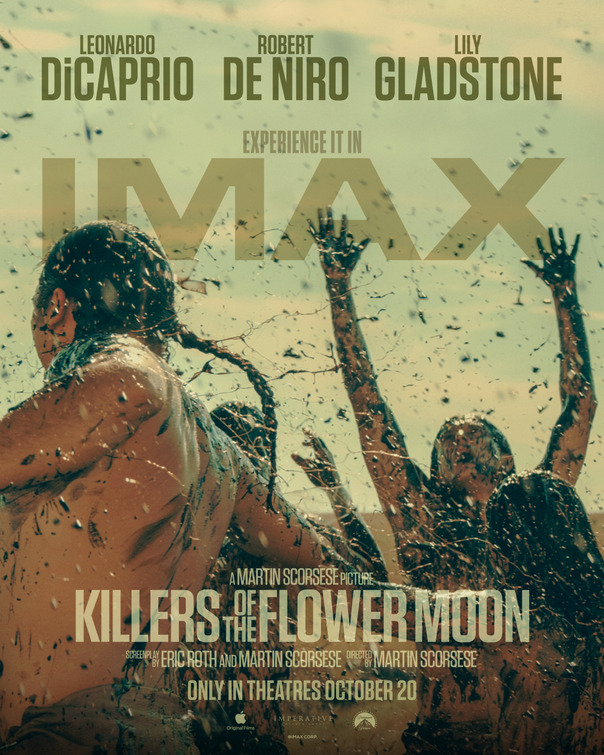
 Killers of the Flower Moon
Director: Martin Scorsese
Cast: Leonardo DiCaprio, Robert de Niro, Lily Gladstone, John Lithgow, Jesse Plemons, Brendan Fraser, Cara Jade Myers, Jason Isbell, Scott Shepherd
Running Time: 3 hours and 25 minutes
Film Rating: 9 out of 10
Based upon the non-fiction book about the murders of the Osage native American Indians in Oklahoma in the 1920s written by David Grann, Oscar winning director Martin Scorsese constructs a masterful opera of a film on a grand scale in his new epic tale of oil, greed, infiltration and subjugation of the indigenous American people by the white population in the Midwest in the artfully constructed Killers of the Flower Moon.
Audiences before watching this film, read up about the history and check that you are comfortable sitting through a three and a half hour film.
At the devilish heart of Killers of the Flower Moon are three brilliant performances by Oscar winner Leonardo di Caprio (The Revenant) as the brutish and slightly dumb Ernest Buckhart who goes and works for his nasty uncle William Hale expertly played with just the right mixture of nuance and notoriety by Oscar winner Robert de Niro (Raging Bull, The Godfather Part II).

At the crux of the manipulative relationship between uncle and nephew, is Mollie Buckhart, a very wealthy Osage woman who along with her mother and sisters hold all the oil rights on their tribal land in central Oklahoma, a superb and stately performance by Lily Gladtsone who deserves a Best Actress Oscar for her sublime performance as she has to slowly realize that the husband she trusted is not what he seems.
Scorsese opens this epic with the Osage dancing and celebrating magnificently as oil pours lavishly out of the hardened soil of Oklahoma, making these tribal American Indians one of the wealthiest in America in the 1920’s but also causing them to become a magnet for infiltrators, con artists and low life criminals.
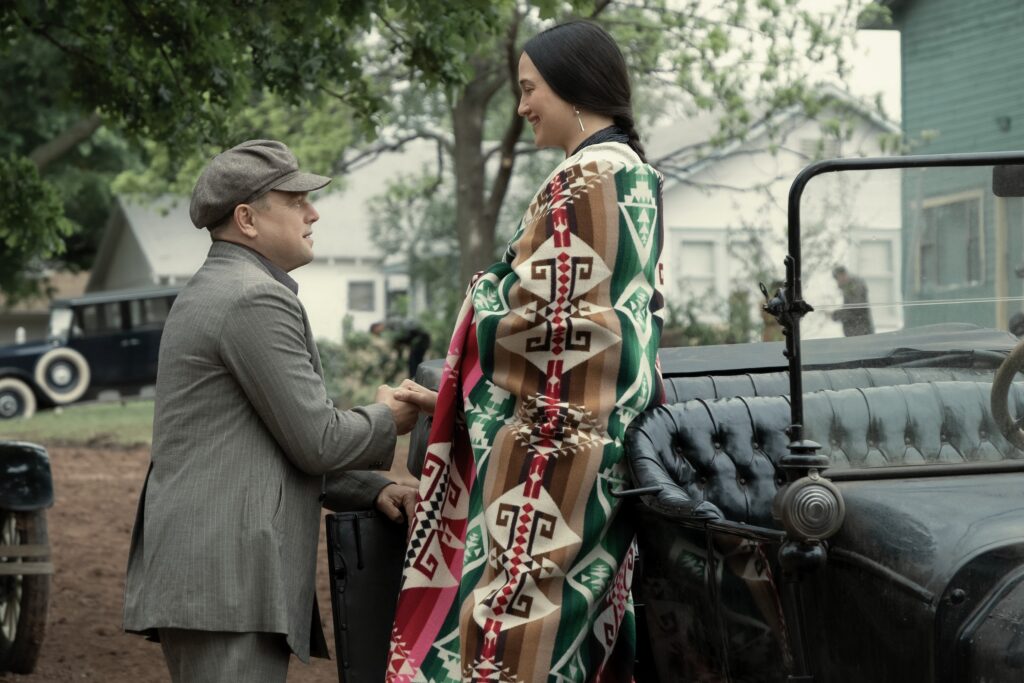
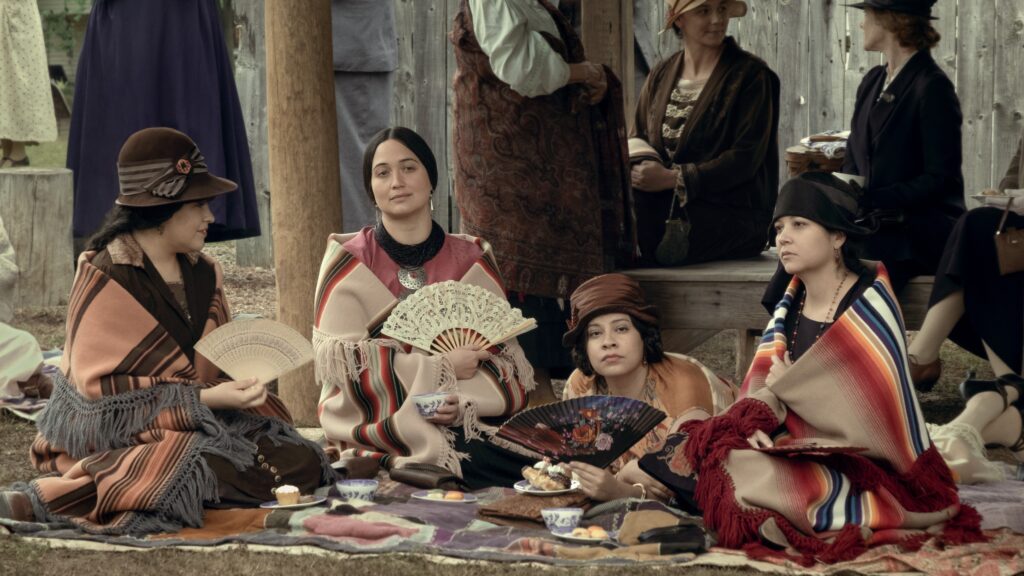
Through planned intermarrying on behalf of the white population, the Americans all conspire like wolves to take down the Osage and use their marital rights to acquire the oil rich lands of this magnificent and stately indigenous tribe, beautifully dressed, aloof and regal. Like the first descendants of a mysterious royalty, an ethnographic image of the other to be captured and subdued.
With authentic costumes by Jacqueline West who was Oscar nominated for costume design for Quills, The Revenant and The Curious Case of Benjamin Button, Killers of the Flower Moon is a fascinating tale about greed, crime and unrelenting corruption. It’s a beautiful ode to the Old American West as it was shedding its allure as an untamed land and becoming an environment for gentrification, embracing all the dangers which come with sudden affluence.
This is a very long film, but if you as a viewer invest in this film you will be the richer for it.
With crackling dialogue by Eric Roth and Martin Scorsese, de Niro and Di Caprio do not disappoint nor do any of the vast supporting cast including Oscar winner Brendan Fraser (The Whale), Oscar nominee Jess Plemons (The Power of the Dog) and Oscar nominee John Lithgow (Terms of Endearment, The World According to Garp) as the prosecutor Peter Leeward who eventually seeks rightful justice for the Osage in a Federal Court.
Killers of the Flower Moon paints a vast and cruel, yet magnificent canvas – a film so rich in detail and information that as an epic it will be treasured as another great entry into Scorsese’s mind blowing filmography of auteur cinema which stretches from Raging Bull through Gangs of New York to The Wolf of Wall Street and beyond.
Killers of the Flower Moon gets a film rating of 9 out of 10 and is a treasured yet masterful cinematic epic. Recommended viewing for those that enjoy fascinating cinema.
 Posted in Martin Scorsese |
  Tags: Brendan Fraser, Cara Jade Myers, Jason Isbell, Jesse Plemons, Leonardo DiCaprio, Lily Gladstone, Robert de Niro, Scott Shepherd |
  Comments Closed
Merciless Revenge
Expendables 4
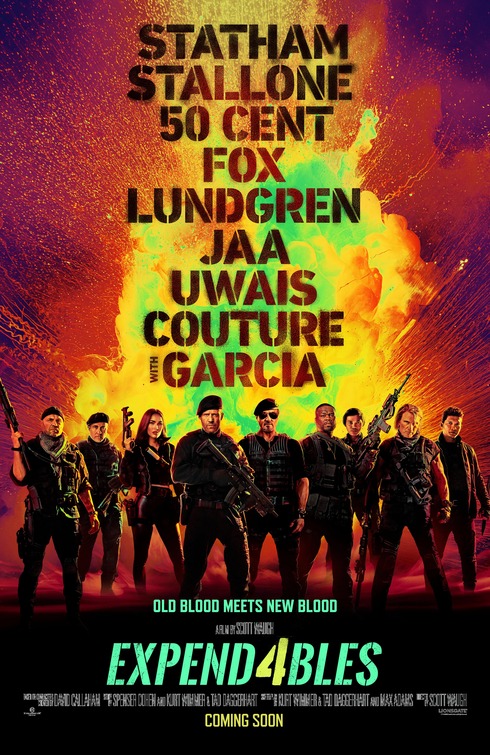
Director: Scott Waugh
Cast: Jason Statham, Sylvester Stallone, Curtis Jackson (50cent), Megan Fox, Andy Garcia, Dolph Lundgren, Tony Jaa, Randy Coutoure, Iko Uwais, Lucy Newman-Williams, Jacob Scipio
Running Time: 1 hour 43 minutes
Film Rating: 6.5 out 10

Need for Speed director Scott Waugh delivers another action packed sequel in the Expendables franchise, Expendables 4 reunites Oscar nominee Sylvester Stallone (Rocky, Creed) with action man Jason Statham from the Fast and the Furious franchise along with Curtis (50 cents) Jackson (Get Rich or Die Tryin), Dolph Lundgren (Aquaman, Masters of the Universe, Red Scorpion, A View to a Kill) and Andy Garcia (Kill The Messenger, The Godfather Part III, Internal Affairs) as the Expendables battle a merciless villain Rahmat superbly played by Indonesian actor Iko Uwais who feels no remorse about annihilating an entire Libyan army or blowing up a nuclear weapon off the coast of Russia.
As the action moves around the world from New Orleans to Libya, from Thailand to Vladivostok, The Expendables team headlined by Barney Ross played by Stallone teams up with Christmas and his gorgeous girlfriend Gina played by the fabulous Megan Fox (Transformers, Confessions of a Teenage Drama Queen) as the team of mercenaries try to prevent Rahmat from using these stolen nuclear detonators in a more nefarious way after his vicious gang steal them from an abandoned army base in post-Gaddafi Libya.

Naturally the screen chemistry between Jason Statham and Megan Fox is phenomenal and like all the other three films in this franchise, The Expendables is always about the tough guys and the action.
In this regard, the explosive action in The Expendables 4 does not disappoint from a motor bike chase aboard an aircraft carrier to the excellent martial arts scenes provided by Tony Jaa as Christmas’s Thai friend Decha who when all dressed up looks like a Teenage Mutant Ninja Turtle.
Expendables 4 is a pure popcorn action film, complete unadulterated escapism which works because the cinema was absolutely full. So if anyone thinks cinema is dead, just come to an Expendables film.

All the cast is proficient in their roles most of whom have done this franchise before and know what the audience want: ballsy tough guy action with planes, boats, bikes and cars. The tough guys have to naturally defend themselves with guns, knives, knuckledusters and swords as they meter out merciless revenge to Rahmat and his gang of bandits.
Action director Scott Waugh delivers a decent sequel to the original trilogy and Expendables 4 gets a film rating of 6.5 out of 10.
See this film for the action and not for the storyline, although there are some surprisingly fresh plot twists. This is recommended viewing for lovers of exciting action films because audiences will definitely not fall asleep in this adventure.
Posted in Scott Waugh |
Tags: Andy Garcia, Curtis Jackson, Dolph Lundgren, Iko Uwais, Jacob Scipio, Jason Statham, Lucy Newman-Williams, Megan Fox, Randy Coutoure, Sylvester Stallone, Tony Jaa |
Comments Closed
Last Child in the Village
The Eight Mountains
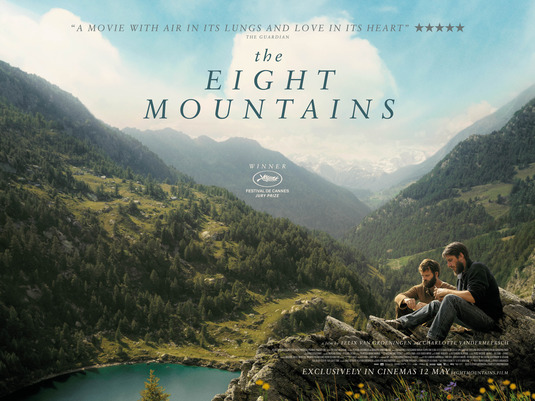
Directors: Felix van Groeningen & Charlotte Vandermeersch
Cast: Luca Marinelli, Alessandro Borghi, Elisabetta Mazzullo, Filippo Timi
Running Time: 2 hours and 27 minutes
Film Rating: 7.5 out of 10
Language: Italian with English Subtitles
Festival: European Film Festival
Belgian directing duo Felix van Groeningen & Charlotte Vandermeersch present the slightly long winded friendship film The Eight Mountains about two young boys who become friends in August 1984 and this film tracks their friendship as they grow into teenagers and eventually into adults.
Both boys are the only child of a family, Pietro Guasti and Bruno Guglielmina become firm friends as they spend the idyllic summers together in the Italian Alps. Pietro is a city boy from Turin with a strict father, Giovanni played by Filippo Timi while Bruno is a child of nature and literally the last child in the village, a remote place in the alps filled with beautiful mountains and stunning scenery but sparsely populated.
As the years go by, Pietro struggles to find his own identity as a man and has a fall out with his aging father although all the time attempting to be a writer and describe his experiences from mountain climbing to studying literature. Bruno just wants to remain in the same area and starts isolating emotionally as he attaches himself more to the natural environment.
Both men follow different dreams although as friends they unite to build a chalet in memory of Pietro’s father. This arduous task completed during the summer months cements their long-time friendship although soon love and self-exploration changes their dynamic. Bruno meets a lovely woman Lara played by Elisabetta Mazzullo and they have a child together, while he dreams of opening his own cheese making farm.
Pietro stretches his wings and travels to Nepal to climb the Himalayas and gain a perspective on his Italian childhood and the lost years that he can’t get back with his late father.
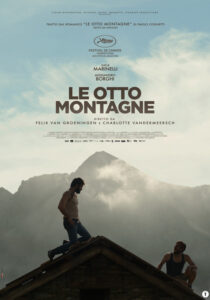
The Eight Mountains is a fascinating if slow moving story of the progression of a male friendship from boyhood until adulthood, all the highs and lows, the family tragedy and the complex relationships. Unfortunately with two directors, this film while interesting does suffer from a lack uniformity regarding cinematic vision.
With spectacular scenery and some insightful philosophical approaches to the fickle nature of human relationships, The Eight Mountains is a story of two men whose trajectories start the same but their destinies are vastly different.
Fortunately both Luca Marinelli (The Great Beauty) and Alessandro Borghi are excellent as the lifelong friends Pietro and Bruno. If audiences enjoy a slow burning tale of platonic friendship, then they will enjoy The Eight Mountains, an interesting story which needed to be edited properly and have a far superior soundtrack. This film’s soundtrack was completely incongruous with the narrative.
While the scenery is gorgeous, The Eight Mountains gets a film rating of 7.5 out of 10 and the storyline needed more conflict to make this friendship narrative more exciting and humorous.
Posted in Charlotte Vandermeersch, European Film Festival, Felix van Groeningen |
Tags: Alessandro Borghi, Elisabetta Mazzullo, Filippo Tumi, Luca Marinelli |
Comments Closed
Dissection of a Marriage
Anatomy of a Fall
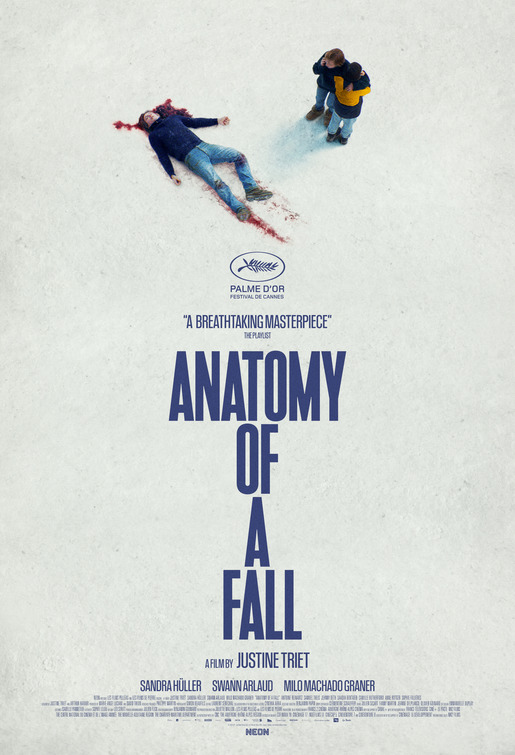
Director: Justine Triet
Cast: Sandra Huller, Swann Arlaud, Samuel Theis, Milo Machado Graner, Antoine Reinartz, Jehnny Beth, Camille Rutherford
Running Time: 2 hours and 30 minutes
Film Rating: 8 out of 10
Languages: English & French
Festival: European Film Festival
French director Justine Triet’s riveting courtroom drama Anatomy of a Fall won the coveted Palm d’Or at the 2023 Festival de Cannes and is a complex dissection of a marriage after it has abruptly ended.
The scenario is set up more like a philosophical question which generates more inquiry than any form of closure.
A couple live in a remote chalet in the French Alps. They have a young son who is visually impaired. One fine day after the wife gives a brief interview to a literary student, the son goes for a walk with his guide dog and returns to discover his father dead on the snow, having fallen from the top floor of the attic window. Was the husband killed or did he commit suicide? If he was killed, there are only two suspects: the wife and the son.
Anatomy of a Fall is a skilfully directed family mystery, in which director Triet’s focus is exclusively on the portrayal of the relationship between mother and son and in particular the role of the mother and the wife, in this case Sandra Voyter superbly played by German actress Sandra Huller (I am Your Man) who actually deserves an Oscar nomination for this role.
Huller’s multi-layered performance in English and French is phenomenal as the less than conventional German mother who finds herself the chief suspect in her French husband’s murder as the criminal trial begins her entire life, her relationship with her husband and their son is dissected in a courtroom in Grenoble, France.
Justine Triet’s portrayal of the husband Samuel is clever and unique, he is almost entirely off-screen except for a key flashback scene in the middle of the film in which the court is played back an audio recording of a marital spate between Samuel and Sandra about six months before his fatal fall.
At the beginning of Anatomy of a Fall, audiences have to watch the opening scene extremely carefully. Unlike in American or even British films, Justine Triet refuses to guide the audience through this complex trial to a satisfactory conclusion, instead she plays with the viewers sympathies as they continually shift between Sandra and her son Daniel, while Sandra is flirting with her French lawyer, the eloquent and sympathetic Vincent Renzi played by Swann Arlaud.
Anatomy of a Fall is a psychological film about a marriage that has collapsed and a family racked with guilt, infidelity and tragedy. Triet also asks the audience to question perspective.
Is an event better to be seen from a male or female point of view? Philosophically speaking who was really responsible for the man falling to his death? Was it the wife or her son? What about motive?
Despite the second half being too long, Anatomy of a Fall is a fascinating film about gender relationships, possible murder and complex marriages.
If audiences enjoy a riveting contemporary courtroom drama, then watch Anatomy of a Fall, for the multi-dimensional performance by Sandra Huller and the intriguing direction of Justine Triet. Anatomy of a Fall gets a film rating of 8 out of 10 and is an intelligent courtroom drama, which will challenge viewers and offer a fresh almost unsettling cinematic perspective.
Posted in European Film Festival, Justine Triet |
Tags: Antoine Reinartz, Camille Rutherford, Jehnny Beth, Milo Machado Graner, Samuel Theis, Sandra Huller, Swann Arlaud |
Comments Closed
Cruelty & Splendour
The Bohemian (Il Boemo)
Director: Petr Vaclav
Cast: Vojtech Dyk, Barbara Ronchi, Elena Radonicich, Lana Vlady, Salvatore Langella, Cristiano Donati
Running Time: 2 hours and 10 minutes
Film Rating: 8 out of 10
Languages: Czech, German & Italian with English subtitles
Festival: European Film Festival
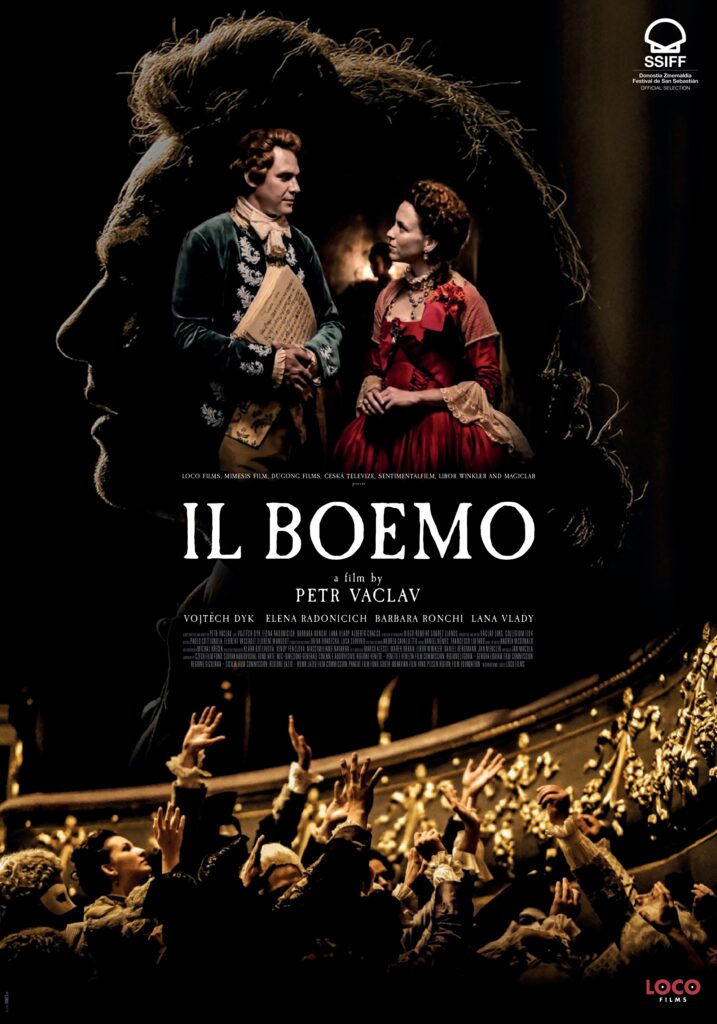
Czech actor Vojtech Dyk plays the role of minor Baroque composer Josef Mysliveček, a Czech composer and precursor of the infamous Mozart in director Petr Vaclav’s lavish and entirely European film The Bohemian or Il Boemo in Italian. The Bohemian is set mainly in Italy at the decadent peak of the Baroque period in classical music in such illustrious centres of culture as Venice, Bologna and Naples.
Josef Mysliveček arrives in Italy to become a famous composer but unlike Mozart he does not rely on anyone royal patron but becomes a more contract composer for various emerging opera companies in Italy during the 1760’s and 1770’s.
Director Petr Vaclav cleverly captures with illumination the excess and drama of the Baroque Opera world in 18th century Italy when wealthy nobleman had composers in their power while the noblewomen and Opera divas were all trying to seduce the composer amidst temptations of candlelit orgies and outrageous theatre antics.
For Mysliveček was truly captivated by the excessively emotional and decadent Italians especially the King of Naples. It was mainly the Opera divas that had the composer working furiously to please them and those wealthy patrons that kept him afloat in Italy after he abandons his family back in Prague. For a hard working Czech composer like Mysliveček in the 18th century, Italy was seen as an illustrious and expensive country, complete with cruelty and dazzling splendour.
The divas in question are Caterina Gabrielli wonderfully played by Italian actress Barbara Ronchi and Anna Fracassati played by Lana Vlady who is utterly superb as an entirely temperamental opera singer that needs to be slapped before performing before the Royal entourage. There is a brilliant scene when the one diva throws herself out of one of the Opera boxes during the performance of an amazing concerto.
The Bohemian is a lavish film, utterly resplendent with beautiful costumes, complete with commedia del arte masks for the Venetian scenes and the operatic scenes are absolutely divine. While not as brilliant as the Oscar worthy film Amadeus, The Bohemian is as amusing and bizarre as director Yorgos Lanthimos’s Oscar winning film The Favourite.

Vojtech Dyk is excellent as the Bohemian composer whose life starts declining rapidly through promiscuity and gambling. Mysliveček watches helplessly as his most promising career as a classical composer slowly vanishes from recognition while the more talented and supremely famous Mozart rises from the ashes of classical Baroque music in a competitive and debauched European cultural world. Ironically like Mozart, Mysliveček also died destitute.
The Bohemian was the Czech Republic’s official entry for the Best International Feature Film Oscar for the 2023 Academy Awards but unfortunately did not make the cut.
If audiences enjoyed Amadeus or The Favourite then they will love The Bohemian which gets a film rating of 8 out of 10 and is especially suited for fans of Baroque Opera who will find this cinematic interpretation intriguing, shocking and dazzling.
Posted in European Film Festival, Petr Vaclav |
Tags: Barbara Ronchi, Cristiano Donati, Elena Radonicich, Lana Vlady, Salvatore Langella, Vojtech Dyk |
Comments Closed
Thrown to the Wolves
The Old Oak
Director: Ken Loach
Cast: Elba Mari, Dave Turner, Claire Rodgerson, Trevor Fox, Chris McGlade, Jordan Louis, Joe Armstrong, Debbie Honeywood, Neil Leiper
Running Time: 1 hour 53 minutes
Film Rating: 7.5 out of 10
Language: English & Arabic
Festival: European Film Festival
With an authentic screenplay by Paul Laverty, The Old Oak is a brilliant social drama about two vastly different communities being forced to live together in Durham, Northern England in the new film by 87 year old British Neorealist film director Ken Loach who also brought the incredible films Land and Freedom and the Irish drama The Wind that Shakes the Barley starring Cillian Murphy.
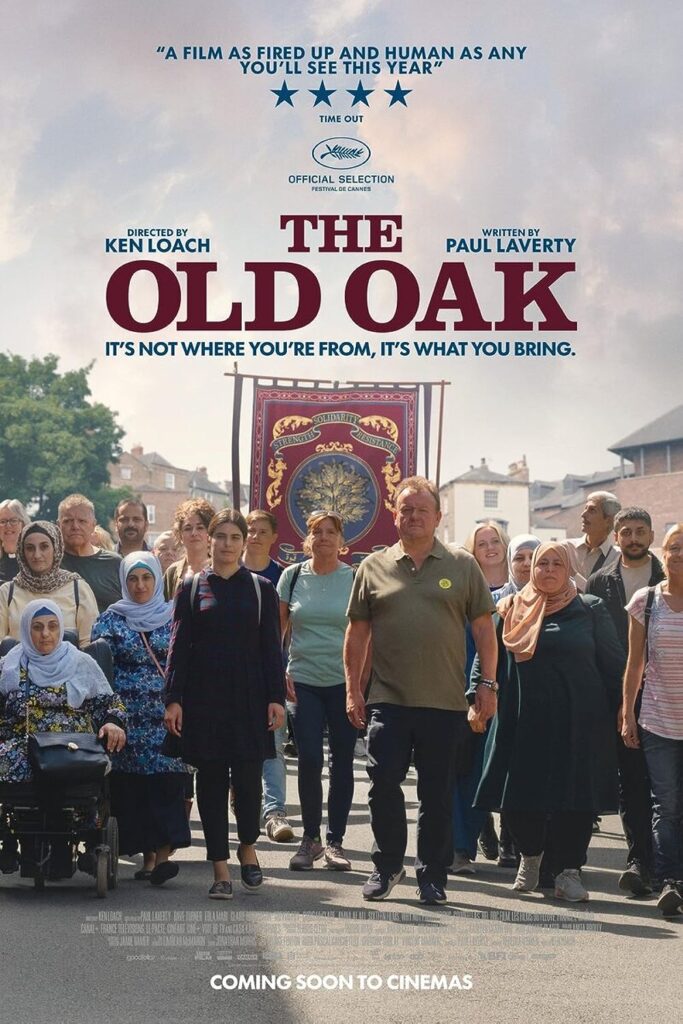
After its well received premiere at the 2023 Festival de Cannes, The Old Oak has no film stars in it, but authentic people, both British and Syrian who are forced to live in close proximity with their only neutral space being The Old Oak, a traditional British pub run by TJ wonderfully played with compassion and sensitivity by Dave Turner.
When Yara, a budding photographer and Syrian refugee arrives in England with her family after escaping the cruelty and atrocities imposed on the Syrian population by the Assad regime, herself and fellow Syrians are treated with hostility by the local former mining community, working class people in Northern England who are at once ignorant but also slightly curious at these completely foreign people arriving and living in their once tight knit community.
Yara is wonderfully played by the beautiful Elba Mari who strikes up a friendship with the pub owner TJ who is desperately trying to hang onto his pub, while his regulars in perfect harmony denounce the arrival of the Syrians calling them names and bemoaning the fact that Westminster has decided to dump refugees in Durham and not in Chelsea or central London.
Ken Loach is known for making razor sharp social dramas dealing with current problems with the British working class and has always portrayed a more socialist viewpoint on the working class as they really are, often poverty stricken, weary of foreigners and salt of the earth people whose community bonds bind them together in mutual distrust of any outsiders.
Screenwriter Paul Laverty gets the pub banter down perfectly of the local regulars at The Old Oak especially conveying the significance of the traditional British pub as the centre of the community and an icon of British culture.
Yara keenly uses the lens of a beautiful camera, which her detained father gave her before they fled Syria to capture the significance of the Syrians arriving in Northern England in 2016.
Director Ken Loach, previous winner of the Palm d’Or for I, Daniel Blake and The Wind that Shakes the Barley is adept at providing a significant film The Old Oak about two different communities fighting to find a neutral space, a venue where they can eat together so that they can stay together.
Ironically, during his highly impressive film career, director Ken Loach has had a bigger following in Europe than in the UK, but his films are always worth watching as he awakens the viewer to social issues which often do not make entertaining film content: xenophobia, cruelty, impoverishment and bigotry.
As a fine example of British Neorealism, The Old Oak is an absorbing tale of two people that find common ground and in doing so draw their respective communities together despite the desperate situation both communities face.
Gritty and authentic, The Old Oak is a clever film, socially insightful and extremely well written and directed, it is worth seeing especially to glimpse a side of Britain which is not mainstream.
The Old Oak, one of Ken Loach’s more complex social dramas gets a film rating of 7.5 out of 10. Highly recommended viewing.
Posted in European Film Festival, Ken Loach |
Tags: Chris McGlade, Claire Rodgerson, Dave Turner, Debbie Honeywood, Elba Mari, Joe Armstrong, Jordan Louis, Neil Leiper, Trevor Fox |
Comments Closed
Death in the Music Room
A Haunting in Venice
Director: Kenneth Branagh
Cast: Kenneth Branagh, Tina Fey, Michelle Yeoh, Jamie Dornan, Riccardo Scarmarcio, Camille Cottin, Jude Hill, Kyle Allen, Emma Laird, Ali Khan
Running Time: 1 hour 43 minutes
Film Rating: 7.5 out of 10
Based upon the bestselling Agatha Christie novel Hallowe’en Party published in 1969, screenwriter Michael Green adapts the murder mystery for director Kenneth Branagh’s new film A Haunting In Venice starring an ensemble cast including Belfast stars Jamie Dornan and Jude Hill plus Oscar winner Michelle Yeoh (Everything, Everywhere all at Once).
So let’s set the scene: a séance on Halloween at a haunted palace in Venice in 1947. What could possibly go wrong?
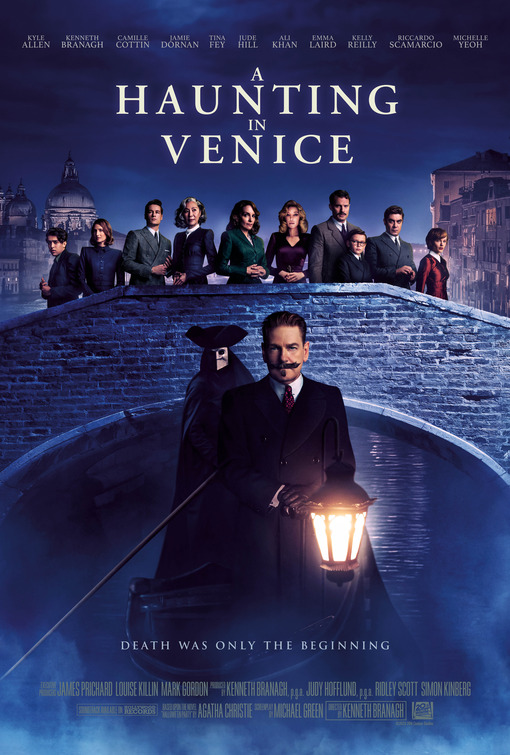
Famed Belgian detective Hercule Poirot is lured to another complex murder mystery by the ambitious writer Ariadne Oliver superbly played with dashes of wit by comedy star Tina Fey to a séance hosted by the doomed Opera star Rowena Drake expertly played with a crisp British accent by Yellowstone star Kelly Reilly (Pride and Prejudice, Flight).
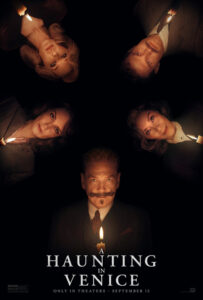
The Femme Fatale Rowena Drake has a host of eclectic guests over for the séance in a bid to bring back the spirit of her dead daughter who drowned in the Venetian canal a year ago. Poirot suspects a far more scientific yet murky plot is afoot despite various inexplicable terrifying occurrences and sightings of potential ghosts.
When the psychic Mrs Reynolds appears with a cloak and a Venetian mask, trouble starts brewing as she expertly assembles her guests in a bid to conjure up the spirit of Rowena’s dead child, but tragedy strikes when not one but two murders occur around midnight on Halloween.
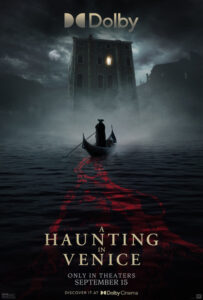
Unlike the dazzling Death on the Nile, Branagh choses a more atmospheric look for A Haunting in Venice taking all his visual clues from classic film noir, with dark shots of the floating city and all the allusions to what Venice as a city represents cinematically: forbidden desire, unfathomable motives and beauty which is deceptive and dangerous.
Branagh keeps the action tight and his ensemble cast including Camille Cottin as Oleg Seminoff and Italian star Riccardo Scamarcio (John Wick 3, Burnt) as corrupt policeman Vitale Portfoglio, all perform perfectly in their roles.
A Haunting in Venice is an extremely dark film, making the entire narrative very murky and difficult to distinguish much like the real motives of the murderer. Branagh possibly had a constrained budget compared to the lavish two previous films: Murder on the Orient Express and Death on the Nile as most of this film takes place in the haunted mansion.
Claustrophobic and scary, A Haunting in Venice is tonally brilliant and fortunately saved by some intelligent screen chemistry between Tina Fey and Kenneth Branagh and will appeal to all those that love a stylish murder mystery. Audiences should look out for an entirely creepy performance by Jude Hill as a precocious boy Leopold Ferrier reading the American Gothic writer Edgar Allan Poe while the other kids are trick or treating.
With richly dark colours like black, red and grey, A Haunting in Venice is pure film noir with a creepy twist and gets a film rating of 7.5 out of 10.
Posted in Kenneth Branagh |
Tags: Ali Khan, Camille Cottin, Emma Laird, Jamie Dornan, Jude Hill, Kelly Reilly, Kenneth Branagh, Kyle Allen, Michelle Yeoh, Riccardo Scamarcio, Tina Fey |
Comments Closed
The Duckling & The Lizard
Close
Director: Lukas Dhont
Cast: Eden Dambrine, Gustav De Waele, Emilie Dequenne, Lea Drucker, Igor van Dressel, Kevin Janssens
Running Time: 1 hour 44 minutes
Film Rating: 8 out of 10
Language: Flemish with English Subtitles
Festival: European Film Festival 2023
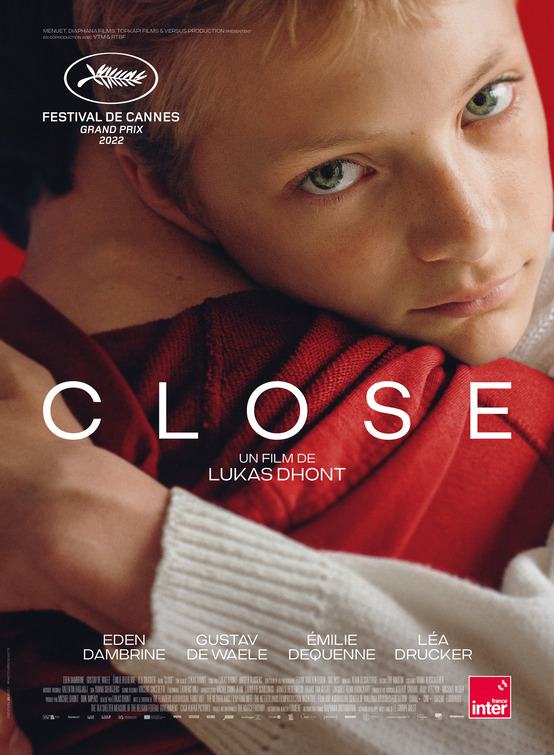
Belgian director Lukas Dhont follows up his 2018 film Girl, with an emotionally complex film Close starring an excellent Eden Dambrine as a teenage schoolboy Leo whose childhood friendship with Remi played by Gustav de Waele goes from being extremely close to being exceptionally difficult as both boys enter high school in contemporary Belgium and experience different feelings.
Dhont whose film Close was nominated for the Best International Film at the 2023 Oscars representing Belgium packs his skilful and emotionally taut storyline into an uncomfortable gaze. Most of the film is shot in extreme close up particularly the opening scenes featuring Remi and Leo as they are childhood friends who spend all their waking hours’ together, playing imaginary games against the so-called enemies and spending all their time at Remi’s house with his mother Sophie, a nurse watching on happily.
In a radical shift in circumstances and as Leo and Remi start navigating the treacherous teenage years of high school, Leo yearns to fit into a bigger crowd at school and as a result of bullying knowingly distances himself from Remi, who doesn’t have the emotional capacity to understand why his best friend has started ghosting him.
Close is expertly shot with that casual European nonchalance which gradually draws the viewer into an absolutely poignant and gut-wrenching film. This top class drama, a razor sharp analysis of young human beings in transition in that tricky stage of puberty when they are attempting to deal with complex relationships and ever shifting feelings.
Leo is suddenly thrust into a morally uncomfortable situation one in which he questions his own version of who he wants to be while trying to make amends.
Co-written by Lukas Dhont, Close not only refers to close friendships or bullying but the rather messy dynamic of family relationships and how children are socialized differently, particularly boys who are brought up to be tough, competitive and resilient. Any sign of weakness is seen to be an opportunity for exploitation.
Close is an absolutely heart wrenching and thoroughly human story about the consequences of treating someone cruelly and the social effects of bullying. Eden Dambrine dominates the story in this riveting and psychologically scarring film about cruelty, unarticulated feelings and redemption.
Close gets a film rating of 8 out of 10 and is highly recommended viewing about complex issues that need to be discussed intelligently. A superb film.
Posted in European Film Festival, Lukas Dhont |
Tags: Eden Dambrine, Emilie Dequenne, Gustav De Waele, Igor van Dressel, Kevin Janssens, Lea Drucker |
Comments Closed
Don’t Miss the Boat
My Big Fat Greek Wedding 3
Director: Nia Vardalos
Cast: Nia Vardalos, John Corbett, Louis Mandylor, Elena Kampouris, Andrea Martin, Joey Fatone, Alexis Georgoulis, Elias Kacavas, Laine Kazan, Gia Carides
Running Time: 1 hour 32 minutes
Film Rating: 6 out of 10
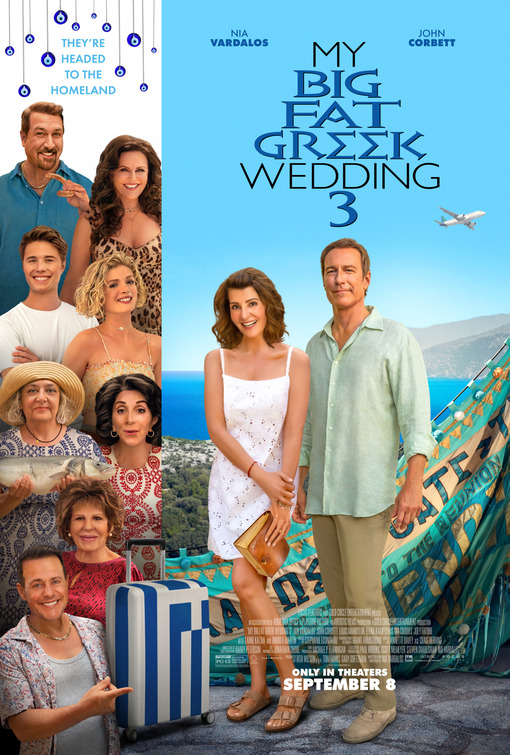
Canadian actress and screenwriter Nia Vardalos returns to the Portokalos family from the original 2002 hit film, My Big Fat Greek Wedding, with the third instalment of the comedy franchise, My Big Fat Greek Wedding 3 written, directed by Vardalos and also starring as the main character Toula Portokalos who this time takes her entire Greek family to Greece to fulfil her late father’s wishes.
From the Greek immigrant community in Chicago to the Greek islands, My Big Fat Greek Wedding 3 is a family romp about a rambunctious extended family who return to their homeland and discover some new family members, several goats and a grumpy Greek old lady who keeps everyone in line.
Whilst the storyline for this third instalment is very thin on the ground, Nia Vardalos unfortunately misses some great comedic moments throughout the film, which is a pity as this could have been exceptionally funny like the Oscar nominated original film back in 2002.
Instead, Nia Vardalos directs a slightly disjointed and incoherent film about a huge Greek family discovering their roots while making some casual references to the immigrant crisis that has besieged Greece in the last 20 years and the generational difference which always comes to light while on holiday as well as some skits on male grooming and Greek cuisine.
Toula’s daughter Paris played by Elena Kampouris is flirting with Aunt Voula’s dashing travel assistant, the young and buff Aristotle played by Elias Kacavas last scene in the TV series Euphoria. Paris and Aristotle meet another young and fun couple, Qamar and Christos while Toula and her gay brother Nick played hysterically by Louis Mandylor discover that they have some new Greek relatives to contend with specifically the gorgeous Peter played by Alexis Georgoulis (My Life in Ruins).
The scenery in this film is gorgeous as is the food. My Big Fat Greek Wedding 3 is relaxing viewing consisting of a carefully selected set of scenes about a chaotic Greek family on holiday in the motherland without a hint of menace. This film isn’t The White Lotus.
Unfortunately, the characters of the Portokalos family have reached their expiry date after nearly 20 years and secondly Nia Vardalos should have left the direction of this film to someone more capable.
With idyllic scenery, My Big Fat Greek Wedding 3 is as about as light as a pita bread with cucumber dip. Judging by how full the cinema was, when I saw this, this film will have mass appeal: it’s about young love, family relationships, death and new beginnings, cross cultural themes that everyone can relate to.
Despite not being brilliant, My Big Fat Greek Wedding 3 is a lovely family comedy and gets a film rating of 6 out of 10. If you are depressed go and watch this film, it will make you want to fly to Greece!
Posted in Nia Vardalos |
Tags: Alexis Georgoulis, Andrea Martin, Elena Kampouris, Elias Kacavas, Gia Carides, Joey Fatone, John Corbett, Lainie Kazan, Louis Mandylor, Nia Vardalos |
Comments Closed
The Blame Frame
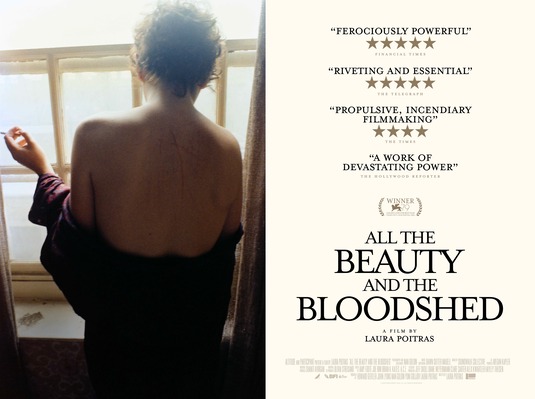
All the Beauty and the Bloodshed
Director: Laura Poitras
Running Time: 2 hours and 2 minutes
Festival: Durban International Film Festival (DIFF2023)
PLEASE NOTE THAT THIS FILM IS A DOCUMENTARY FEATURE
Even before viewers watch film maker Laura Poitras Oscar nominated documentary All the Beauty and the Bloodshed, they should read the New Yorker journalist’s superbly researched book Empire of Pain: The Secret History of the Sackler Dynasty by Patrick Radden Keefe who gives a detailed account of the complex issues surrounding the extensive opioid crisis that gripped America for the first 20 years of the 21st century.
Poitras chooses to follow the bohemian life of photographer and activist Nan Goldin who herself got addicted to OxyContin and then once recovered launched a successful smear campaign again the Sackler Family who owned the Pharmaceutical giant Purdue Pharma who made and distributed the highly addictive strong pain killer OxyContin, which is a derivative of heroin.
All the Beauty and the Bloodshed focuses on Goldin’s smear campaign, who as an artist who had her work hung in some of the world’s most prestigious galleries from The Met to the Guggenheim and the Louvre, attacked the immensely wealthy Sackler’s families philanthropic efforts of donating huge amounts of money to galleries in New York, London and Paris with the proviso that the cultural institution name a wing of the gallery after the Sackler’s.
With a brilliant title, All the Beauty and the Bloodshed, documentarian Laura Poitras makes her position clear that she is on the side of Nan Goldin and does not maintain an objective gaze but instead scandalizes the actual smear campaign which was both riveting and explosive as Nan Goldin and her gang of activists stages protests in the Guggenheim throwing thousands of prescription OxyContin bottles down the spiral ramp of the Guggenheim, the most glamourous art gallery in New York. Goldin does a similar protest at the Louvre where the European wing of the Sackler’s who were based in London had donated large amounts of money.
Laura Poitras does do a full comprehensive historical biography of Nan Goldin from her counterculture days as an emerging photographer in New York surrounded by fringe film makers and queer artists to her own addiction struggles and to the scourge of the AIDS crisis in the late 1980’s which nearly wiped out that entire counter-culture community.
Ultimately what Poitras does do is paint the immensely clever and secretive Sackler clan as aloof billionaires who had invented a drug which was abused by millions of Americans and many died, while not accepting any responsibility for how they had contributed to the Opioid epidemic from 2000 to 2020, while vastly benefiting from the immense profits made by their Pharmaceutical company.
The faces of Kathe and Richard Sackler, some of the heirs of the vast wealth of the Sackler clan, as appearing cold and unsympathetic at the end of the documentary when the family is deposed virtually in 2020 to appear before the families of the victims who died during this crisis, paints the family that privately owned Purdue Pharma as completely unsympathetic, which they were. The Sackler’s did not acknowledge guilt or accountability but through the efforts of Nan Goldin and her gang of protesters, years of philanthropy have been stripped at some of the finest cultural institutions in the world as the Sackler name was erased from the esteemed Art World.
As a documentary film maker, Laura Poitras does a superb job of bringing the opioid crisis to light and how the once influential Sackler family lost their reputation but not their wealth. All The Beauty and the Bloodshed is a fascinating if slightly one sided documentary which is tangential in parts but illuminating in other.
While the complex ethics of pharmaceutical distribution is largely untouched in this documentary, the focus squarely remains on the Sackler’s enormous contribution to the World of Art and their untimely undoing by a spiralling opioid crisis and Federal litigation. See this documentary in conjunction with reading Patrick Radden Keefe’s brilliant non-fiction book, to gain the full complex history of the Sackler family and the opioid crisis in America.
All the Beauty and the Bloodshed gets a film rating of 8 out of 10 and is a fascinating tale of counterculture flamboyance and protest versus corporate greed and murky philanthropy to some of the most influential art galleries in the World: The Louvre, the Guggenheim, The Tate and the Met. Highly recommended viewing.

- Don’t Feel Like Cooking This Holiday Season? These Meal Delivery Services Have You CoveredIt’s time to start thinking up festive meal ideas for Christmas and New Years. But if you’re already wiped out from all the cooking that family get-togethers entail during this time of year (or have never liked spending too much time in the kitchen) there are countless delivery and meal prep services that promise delicious […]Atingley4
- These Coffee Subscription Services Make the Perfect Last-Minute GiftFrom drip coffee makers to French presses to pour-overs, there are numerous ways to make a quality cup of coffee. But avid coffee drinkers know that the beans are the most important, which is why subscription services that expertly curate artisanal and locally-sourced beans are so worth the money. Plus, it makes for the perfect […]
- Last-Minute Gifts Delivered in Time for Christmas: From Wine Subscriptions to Spa AppointmentsIf you have a tendency to leave shopping to the very last second, you’re certainly not alone. While there’s still ample time to procure the perfect gift, if you do procrastinate this year, you’ve still got plenty of options that you can order and send instantly online — but will actually look like you didn’t […]Atingley4
- ‘Stranger Things 5′ Confirms Runtimes for Series’ Final Four Episodes; Finale Is Two Hours and Eight Minutes“Stranger Things” co-creator Ross Duffer has revealed the runtimes for the final four episodes of the series. After the first four episodes of Season 5 were released on Nov. 26, “Stranger Things” will return for another three episodes on Christmas Day, with the series finale coming on New Year’s Eve. Episode 5, titled “Shock Jock,” […]Selome Hailu
- ‘The Housemaid’ Book Series Jumps to Top of Bestseller Lists Following Sydney Sweeney and Amanda Seyfried MovieFreida McFadden’s “The Housemaid” is back to the top of bestseller lists again following the release of the film adaptation starring Sydney Sweeney and Amanda Seyfried. The psychological thriller, originally a breakout hit when it first came out in 2022, is set on Long Island and centered on a down-on-her-luck young woman who takes a […]Atingley4
- Podiatrists and Nurses Can’t Stop Recommending These $54 Sneakers December 22, 2025The rise of orthopedic-inspired sneakers is one trend we’re more than happy to embrace. Supportive, cloud-like walking shoes are officially in—and thankfully, they no longer come with luxury-level...
- Barry Manilow Shares Lung Cancer Diagnosis December 22, 2025Barry Manilow is embarking on a health journey. The “Mandy” singer shared that he has been diagnosed with an early stage of lung cancer following a battle with bronchitis earlier this year. “My...
- James Ransone's Wife Jamie McPhee Speaks Out After His Death December 22, 2025James Ransone’s widow is putting on a brave face. Days after the It Chapter Two star’s death at age 46, his wife Jamie McPhee shared a bittersweet message honoring his life. “I told you I have...
- Gabourey Sidibe & Brandon Frankel Attend Disney on Ice With Twins December 22, 2025Gabourey Sidibe and Brandon Frankel’s twins marked a hot diggity dog milestone. The Empire actress’ husband documented the family’s outing at Disney on Ice Presents Let’s Dance! on Dec. 20 which...
- Kate Winslet Shares She Was Told to "Settle for the Fat Girl Parts" December 22, 2025Kate Winslet is looking back at a difficult chapter of her life. The Titanic star reflected on the negative comments she received about her body at the beginning of her acting career. "I was a...
- Read MoreDifferent providers offer different cell phones, so take a look at the options from each provider to choose the right one for you. You may also want to look into any promotions that the providers have to offer, such as free cell phones in exchange for signing a contract. Tags: 2gmhass90