Archive for the ‘African cinema’ Category
Our Last Day in Lagos
 September 6th, 2026 |
  Author:
 My Father’s Shadow
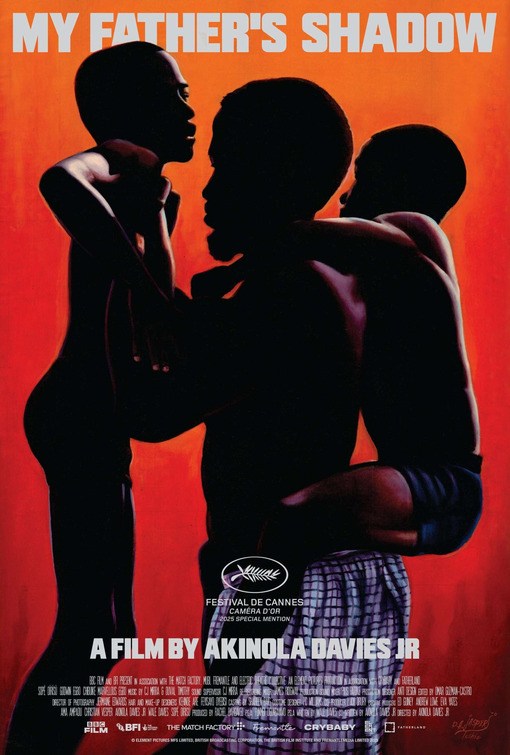
Director: Akinola Davies Jr
Cast: Sope Dirisu, Godwin Egbo, Chibuke Marvellous Egbo
Running Time: 1 hour and 34 minutes
Film Rating: 7 out of 10
Film Festival: European Film Festival 2026
Language: English
After premiering in the Un Certain Regard section of the 2025 Cannes Film Festival, British Nigerian director Akinola Davies Jr’s impressive debut film My Father’s Shadow is a touching and poignant story of a journey a father takes with his two sons through Lagos, Nigeria in the summer of 1993 on the eve of the announcement that the presidential elections had been nullified resulting in catastrophic political unrest in the country.
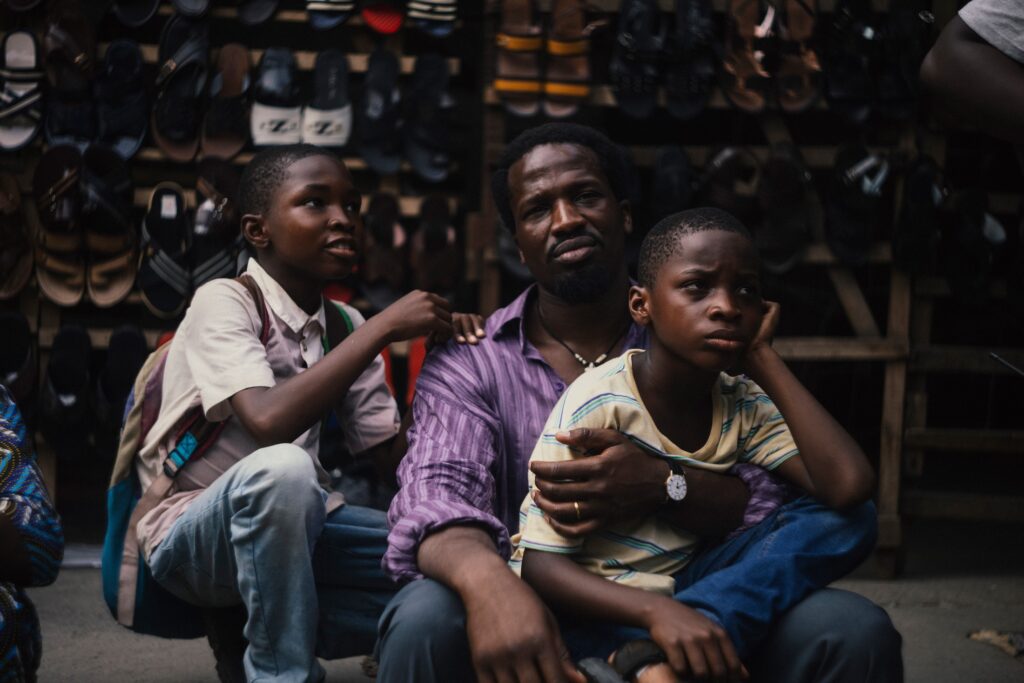
What makes My Father’s Shadow unique, is that it is told through the eyes of two young brothers aged 8 and 11, Remi and Akin played respectively by Chibuke Marvellous Egbo and Godwin Egbo.
As the film begins the boys are playing in an impoverished yard with cut out paper action figures, imagining a world of superhero’s and villains. The sudden arrival of their big strong father Folarin expertly played by Sope Dirisu (Mothering Sunday), who decides on a whim to take his sons with him on an arduous journey into downtown Lagos to collect some back pay owed to him.
As Folarin and his sons travel from the Yoruba village into Lagos, their transport is communal, getting rides in taxis with fuel shortages and then with motorbikes until their final arrival in the bustling and vibrant centre of the biggest city in Nigeria.
Remi and Akin are oblivious to the simmering political unrest that is about to occur. The brothers relish the time with their father who visits his work colleague and even eats at a café where he sees his city mistress.
Akinola Davies Jr’s film is filled with foreshadowing images of vultures circling over the city as his camera pans across Lagos encompassing the diversity of religion both Christian and Muslim and also the vibrancy of the city with an authentic African energy.
My Father’s Shadow does employ non-European film techniques whereby every frame is filled with the community and how they relate to each other, avoiding making the individual the focus. However the narrative is slow and the ending of this film will leave viewers pondering whether the journey was imaginary or remembered.
The best scene in the film is on the beach in Lagos when Folarin tells his sons how much he loves them as they recover from swimming in the Atlantic Ocean. It’s a beautifully shot scene which specifically highlights masculine vulnerability and that sometimes tenuous connection between a father and his sons, bordering on honour, humour and hero worship.
A prime example of vital African cinema and made history as the first Nigerian film to be selected for the Cannes Film Festival, My Father’s Shadow is a surreal and significant achievement although the film’s narrative which was co-written with the director’s brother Wale Davies could have been stronger and more specific.
My Father’s Shadow gets a film rating of 7 out of 10 and is enjoyable. Recommended viewing.
 Posted in African cinema, Akinola Davies Jr, European Film Festival |
  Tags: Chibuke Marvellous Egbo, Godwin Egbo, Sope Dirisu |
  Comments Closed
Escaping the Community
Banel & Adama
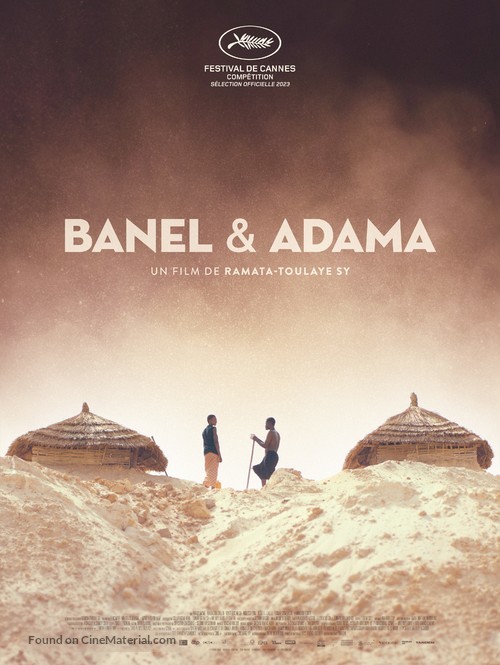
Director: Ramata-Toulaye Sy
Cast: Khady Mane, Mamadou Diallo, Binta Racine, Moussa Sow
Running time: 87 minutes
Film Rating: 6.5 out of 10
Festival: Durban International Film Festival (DIFF)
Language: Sengalese with English Subtitles
After having its world premiere at the 76th Festival de Cannes, Sengalese director Ramata-Toulaye Sy ‘s thought provoking film Banel and Adama was chosen as the closing film of the 44th Durban International Film Festival in July 2023.
Banel and Adama won the Bright Horizon award at the Melbourne International Film Festival and is an incisive look at woman Adama who is supposedly trapped in a patriarchal and remote village in Northern Senegal.
Adama’s future is mapped out for her by the village elders as she is to wed the younger brother of her late husband as per tradition. However, Banel played by Mamadou Diallo is not happy with her projected future and struggles to adapt to an already mapped out life. As a young woman she struggles to take heed of advice by the village elders even when the village itself is ravaged by drought and lack of rain.
Banel is to inherit the title as village elder and along with all the men, he has to tend to the dwindling livestock in ever worsening conditions with inadequate agricultural means and a meagre population which is teetering on the edge of hunger.
Unlike Western cinema which always focuses on the interplay between hero and villain, director Rama-Toulaye Sy paints a vivid cinematic portrait of a community struggling to survive against nature and of a woman fighting to establish her own self-identity in an environment which is prescribed by traditional Muslim values and a superstition of all things individual.

Banel and Adama is a fascinatingly authentic African film, a lens which is rare for cinema going audiences from a country which has virtually no visibility on the world stage.
Interwoven with some beautifully stark images, Banel and Adama is a symbolic tale of how an individual woman fights against the expectations of her community and a man who has to bow down to local pressure to take up the position of village leader as inherited according to dictated custom.
Debut director Rama-Toulaye Sy imbues her first film with all the traits of traditional African cinema, minimal sets and a stark production design, while skilfully keeping her narrative community driven as her two main characters battle to accept the fates that have been chosen for them by the village elders.
Posted in African cinema, DIFF, Ramata-Toulaye Sy |
Tags: Binta Racine, Khady Mane, Mamadou Diallo, Moussa Sow |
Comments Closed

- Michael De Luca and Pamela Abdy to Depart at Warner Bros. Following Paramount CloseMichael De Luca and Pamela Abdy’s term as chiefs of Warner Bros. is coming to an end. Multiple sources told Variety that De Luca and Abdy will not be part of David Ellison’s management team after the merger between Paramount Skydance and Warner Bros. Discovery closes. The landmark $110 billion pact is expected to be […]Angelique Jackson
- ‘Cameron Winter at Carnegie Hall’ Review: Paul Thomas Anderson Directs a Rapturous Solo Concert Movie Built Around the Songs — and Haunting Sound — of Cameron WinterThe slow rolling piano echo through the hall like a rhapsody from the deep. The sound is rich, lustrous, bottom-heavy, grand. And that voice! Winter sings in a low baritone (and occasionally a high one) of astonishing power, the notes hanging there in a suspended quaver so bold it’s hypnotic.Owen Gleiberman
- Ben Affleck’s ‘Animals’ Cast Wants Him to Run for Office: ‘Maybe They Hate Me’Ben Affleck plays a Brentwood businessman running for Los Angeles mayor in the new thriller “Animals.” The Oscar winner, who directed and co-wrote the film, is also a longtime political activist who has supported the presidential campaigns of Barack Obama, Hillary Clinton, Joe Biden and Kamala Harris. Now, his “Animals” cast would like him to […]Marcmalkin
- Ken Urker, Gypsy-Rose Blanchard’s Partner, Dies at 34Ken Urker, the partner of Gypsy-Rose Blanchard and father of their child, was found dead Thursday in Raceland, Louisiana. He was 34. Captain Brennan Matherne of the Lafourche Parish Sheriff’s Department said in a statement to Variety, “We responded to a residence at 107 Double H Drive, Lot 4, in Raceland today after receiving a […]Pat Saperstein
- International Oscar Submissions: Cuba, Denmark, Vietnam, Italy, France and More Join the ListThe campaigns for the Oscar for international feature film are gaining momentum, with final submissions due by Oct. 1. The Oscars shortlists will be revealed on Dec. 15, with 15 international films selected to be voted on by Academy members in all branches who commit to watch all 15 films. Oscar nominations will be revealed […]Pat Saperstein
- Verity Movie Versus Book: Paging Through the Differences October 2, 2026Get ready, BookTok.Because after Colleen Hoover’s novels It Ends With Us, Regretting You and Reminders of Him were turned into movies, the film adaptation of her thriller Verity is finally in...Elyse Dupre
- Gypsy Rose Blanchard Says Partner Ken Urker Died After Overdose October 2, 2026Gypsy Rose Blanchard is speaking out in the wake of her boyfriend Ken Urker's death. Hours after police confirmed to E! News that Urker was found dead in Louisiana on Oct. 1, the Life After Lock...Gabrielle Chung
- Inside Gypsy Rose Blanchard's Life With Ken Urker Before His Death October 2, 2026Gypsy Rose Blanchard is weathering an unimaginable tragedy. The Life After Lock Up star's boyfriend Ken Urker died on his 34th birthday on Oct. 1 in Louisiana, the Lafourche Sherriff’s Office...Gabrielle Chung
- Why Miranda Lambert Says She, Carrie Underwood Deserve a Ribbon October 2, 2026Miranda Lambert is looking back at the industry that built her. The “House That Built Me” singer reflected on the early days of her country music career and how she and Carrie Underwood were among...Bentley Maddox
- Gypsy Rose Blanchard's Boyfriend Ken Urker Dead at 34 October 2, 2026Gypsy Rose Blanchard is navigating a death in her family. The Life After Lock Up star's boyfriend Ken Urker died on Oct. 1, the Lafourche Sherriff’s Office confirmed to E! News. He was 34. "We...Lindsay Weinberg
- Read MoreDifferent providers offer different cell phones, so take a look at the options from each provider to choose the right one for you. You may also want to look into any promotions that the providers have to offer, such as free cell phones in exchange for signing a contract. Tags: 2gmhass90