Author Archive
69th BAFTA AWARDS
 February 16th, 2016 |
  Author:
 THE 69th BAFTA AWARDS /
THE BRITISH ACADEMY FILM AWARDS
Took place on Sunday 14th February 2016 in London
BAFTA WINNERS IN THE FILM CATEGORY:

Best Film: The Revenant
Best Director: Alejandro G. Iñárritu – The Revenant
Best Actor: Leonardo DiCaprio – The Revenant

Best Actress: Brie Larson – Room

Best Supporting Actor: Mark Rylance – Bridge of Spies

Best Supporting Actress: Kate Winslet – Steve Jobs
Rising Star Award: John Boyega

Best British Film: Brooklyn directed by John Crawley

Best Original Screenplay: Tom McCarthy and Josh Singer – Spotlight

Best Adapted Screenplay: Adam McKay and Charles Randolph – The Big Short

Best Costume Design: Jenny Beavan – Mad Max Fury Road

Best Foreign Language Film: Wild Tales directed by Damián Szifron (Argentina)
Source: 69TH BAFTA AWARDS
 Posted in Alejandro González Iñárritu, BAFTAS, Damián Szifron, John Crawley |
  Tags: Brie Larson, John Boyega, Kate Winslet, Leonardo DiCaprio, Mark Rylance |
  Comments Closed
Breaking the Cardinal Rule
Spotlight

Director: Tom McCarthy
Cast: Michael Keaton, Mark Ruffalo, John Slattery, Rachel McAdams, Liev Schreiber, Stanley Tucci, Billy Crudup, Paul Guilfoyle, Jamey Sheridan
Spotlight refers to a team of investigative reporters stationed at the Boston Globe. Just months before 9/11 in mid-2001, The Boston Globe hires a news editor fresh from Miami, Marty Baron played by Liev Schreiber (The Reluctant Fundamentalist) who subsequently instructs the Spotlight team headed up by Robby Robinson played by Michael Keaton (Birdman) to investigate the systematic child abuse which is happening in the Catholic Church specifically in the Archdiocese of Boston, a strongly Irish Catholic community as highlighted by a recent case pending at the criminal court.
Director Tom McCarthy’s film Spotlight is compelling viewing, a riveting tale of tough investigative journalism by a team of men and woman who will stop at nothing to uncover the truth. The Spotlight team also consists of journalists Sacha Pfieffer brilliantly played by Rachel McAdams (A Most Wanted Man) who pursues testimony from the alleged victims of child abuse and Portuguese descendant Mike Rezendes superbly played by Mark Ruffalo (Foxcatcher) who goes after the legal aspects of the case that lawyer Mitchell Garabedian, played by Stanley Tucci is making against a particular Catholic priest John Geoghan.

As the investigation continues, the journalists realize that what they are uncovering is a much wider scandal of how the Catholic Church not only knew about errant priests committing sexual abuse preying upon vulnerable minors but also how this powerful institution discreetly got these priests transferred or they were given supposed sick leave to avoid exposure or damage to the Church’s reputation.
As they investigate all the priests in the Boston area, the Spotlight team uncovers a much wider pattern of abuse by several priests. However, before they can publish a damning expose they need to have irrefutable proof that this was occurring.
That proof comes in the form of victim testimonies that Garabedian attached as legal documents in a case that he is building against Geoghan and that the Church tried to cover up these legal documents, thus breaking Cardinal Law.
McAdams and Ruffalo are particularly brilliant in Spotlight as journalists who not only uncover a massive and systemic scandal but are forced to question their own religious and spiritual convictions.
What actor turned director McCarthy avoids doing is standing in judgement of the Catholic Church, but rather focuses on the relentless pursuit of facts and absolute proof that investigative journalism is based upon, both of which need to be authenticated before any expose is subsequently published. With a screenplay by Josh Singer and Tom McCarthy, Spotlight is a superb indictment against one of the most powerful religious institutions in the world but also emphasizes the absolute necessity for responsible and comprehensively researched investigative journalism.
When the Spotlight story eventually does go to print, the expose points to a much wider problem in many archdioceses across America and other parts of the world, something which news editor Marty Baron alludes to in the beginning of the investigation.
The cast of Spotlight are phenomenal and deservedly won a 2016 Screen Actors Guild award for best cast and the intelligently crafted story is essential viewing. Spotlight is highly recommended viewing for those that enjoyed such films as All the Presidents Men and Frost/Nixon.
Posted in Tom McCarthy |
Tags: Billy Crudup, Jamey Sheridan, John Slattery, Liev Schreiber, Mark Ruffalo, Michael Keaton, Paul Guilfoyle, Rachel McAdams, Stanley Tucci |
Comments Closed
Outback Red is Back in Fashion
The Dressmaker

Director: Jocelyn Moorhouse
Cast: Kate Winslet, Judy Davis, Liam Hemsworth, Hugo Weaving, Caroline Goodall, Sarah Snook, Kerry Fox, James Mackay
Australian director Jocelyn Moorhouse (How to Make an American Quilt) returns to form in this hilarious and bitter-sweet black comedy The Dressmaker combining the talents of Oscar winner Kate Winslet (The Reader) and Oscar nominee Judy Davis (A Passage to India, Husbands and Wives) in a story about Tilly Dunnage who returns to the Australian outback to avenge the townsfolk who sent her packing when she was 10 years old, blaming her for the death of a young boy.
The Dressmaker is The Scarlett Letter with style, as Winslet delivers a fabulous performance as the tenacious dressmaker Tilly Dunnage who returns to Dungatar, Australia in the earlier 1950’s after a sojourn in Europe’s fashion capitals to look after her mother, Mad Molly Dunnage, wonderfully played by Judy Davis. The onscreen chemistry between Winslett and Davis makes this tale of sweet revenge crackle with delight and is a testament to a brilliant stroke of casting.
The male leads are played by Australian actors Liam Hemsworth (Paranoia, Empire State, The Hunger Games trilogy) and Hugo Weaving recapturing some of that cross dressing glamour which he become so famous for in Priscilla, Queen of the Desert as the closeted cop Horatio Farrat.

Based upon the novel by Rosalie Ham, The Dressmaker is a brilliant and biting black comedy about the drawbacks of small town life: ignorance and the dangers of gossip as a weapon of exclusion.
Tilly Dunnage, always looking absolutely gorgeous despite being in the dusty Australian outback, slowly wins the hearts of the female population of the small town as she becomes a prized dressmaker transforming the plain grocer’s daughter Gertrude Pratt into a gorgeous visionary now known as Trudy.
As Tilly manages to re-establish a bond with her mad mother Molly, she also befriends the local hunk Teddy McSwiney played by Hemsworth and in one hilarious scene she even has to take his measurements for a new suit while he stands shirtless in front of Tilly and her mad mother.
With artistic references to Sunset Boulevard and South Pacific, The Dressmaker is an absolute gem of a film, a wicked black comedy which truly shows Winslet in her most glamorous role to date, taking on the town and correcting the wrongs of the past. Judy Davis is brilliant as the mad mother Molly who confronts her own demons in a town which has long since cursed her.
The rest of the cast include Sarah Snook as the fickle Gertrude Pratt, Kerry Fox (Shallow Grave) as the evil Beulah Harridiene, Caroline Goodall as the pushy mother Elsbeth and the dashing James Mackay as the eligible William Beaumont.
The Dressmaker is highly recommended viewing, a superb and fashionable way to spend two hours and indulge in all the antics of a small town drama filled with mystery, panache and revenge.
Posted in Jocelyn Moorhouse |
Tags: Caroline Goodall, Hugo Weaving, James Mackay, Judy Davis, Kate Winslet, Kerry Fox, Liam Hemsworth, Sarah Snook |
Comments Closed
Cape Cod Sea Rescue
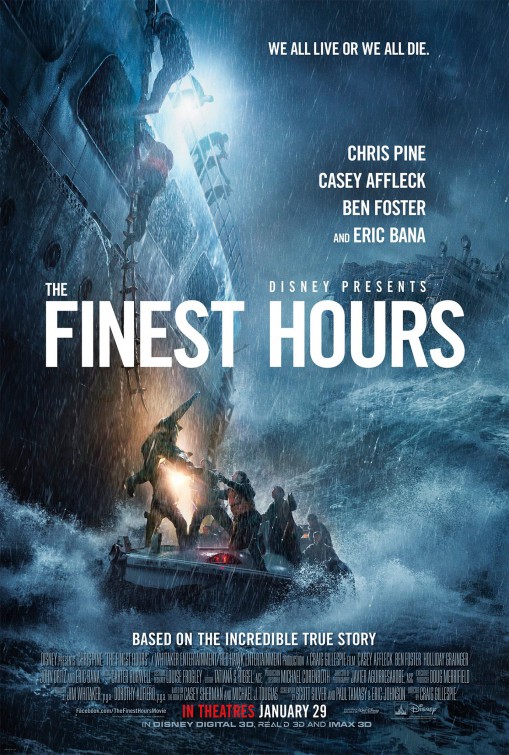
The Finest Hours
Director: Craig Gillespie
Cast: Casey Affleck, Ben Foster, Chris Pine, Eric Bana, Holliday Grainger, John Magaro, Kyle Gallner, John Ortiz, Michael Raymond-James
Million Dollar Arm director Craig Gillespie brings to cinematic life the true story of one of the greatest small boat rescue operations ever attempted by the US Coast Guard in his new film, The Finest Hours featuring a cast of rising Hollywood actors including Chris Pine, Ben Foster and Casey Affleck.
Chris Pine stars as the shy yet brave coast guard officer Bernie Webbers who on the day of asking his commanding officer for permission to marry the gorgeous Miriam Pentinen played by Holliday Grainger (Great Expectations) is sent on a tough mission to save the crew of an oil tanker SS Pendleton which broke in half during a monstrous storm in the Atlantic ocean off the coast of Chatham, Massachusetts.
The Finest Hours is based on the The Finest Hours: The True Story of the U.S. Coast Guard’s Most Daring Sea Rescue by Michael J. Tougias and Casey Sherman and developed into a screenplay by Eric Johnson, Scott Silver and Paul Tamasy. Aboard the SS Pendleton is seaman Ray Sybert, who realizes that after the tanker has been ripped in to two by a massive storm the only way for his crew to survive is if they run the ship aground as using lifeboats during such awful weather would only result in serious loss of life.
Sybert expertly played by Oscar nominee Casey Affleck (The Assassination of Jesse James by the Coward Robert Ford) reassures the crew that they have to sit tight on the remaining section of the tanker in the hope that a rescue mission is being sent out for them.
That rescue mission is headed by Webbers with the assistance of seamen Richard Livensey played by Ben Foster last seen in The Program, Andy Fitzgerald played by Kyle Gallner and Ervin Maske played by John Magaro last seen in Carol.
As The Finest Hours is set in February 1952, and the maritime rescue technology then was not quite advanced as it in the 21st century, the feat of this rescue mission is truly inspirational. Viewers could also be forgiven for wondering how such a small rescue boat CG36500 is able to save over twenty men aboard a stranded oil tanker out in the roaring and unforgiving North Atlantic Ocean during a horrendous winter storm.
The Finest Hours is captivating as a historical drama although the palette for the film is a bit dark and indistinguishable, but director Craig Gillespie did this intentionally so to visually submerge the audience in a real life sea rescue mission off the coast of Cape Cod during a winter blizzard.
The visual effects are amazing and those that enjoy historical dramas should definitely see The Finest Hours. The cast is superb given the material they work with and despite a lack of dialogue, the drama of a sea rescue mission is conveyed accurately although not as good as the excellent film Captain Philips.
Posted in Craig Gillespie |
Tags: Ben Foster, Casey Affleck, Chris Pine, Eric Bana, Holliday Grainger, John Ortiz, Kyle Gallner, Michael Raymond-James |
Comments Closed
The Portrait of Lili
The Danish Girl

Director: Tom Hooper
Cast: Eddie Redmayne, Alicia Vikander, Amber Heard, Matthias Schoenaerts, Ben Whishaw, Sebastian Koch, Sophie Kennedy Clark
After the phenomenal success of The Kings Speech and Les Miserables, director Tom Hooper returns to the art film, in the transgender drama The Danish Girl set in Copenhagen in 1926 starring Oscar winner Eddie Redmayne (The Theory of Everything) and Alicia Vikander (Testament of Youth, Anna Karenina).
Based upon the novel by David Ebershoff, The Danish Girl focuses on the extraordinary story of the artistic couple Gerda and Einor Wegener, a husband and wife team who rise to fame when the husband Einor decides to take on the personality of a woman Lili Elbe, who initially was an artistic experiment so that Gerda could paint her husband dressed as a woman. What Gerda soon realizes is that Einor’s penchant for silk stockings and furs goes far beyond the being the subject for a portrait.
In a series of radical costume changes, always looking absolutely gorgeous Einor slowly shed his masculine persona and becomes the dainty and gorgeous Lily Elbe, even stepping out in public at an artist’s ball, where she, Lily attracts the attention of Henrik played by Ben Whishaw (Brideshead Revisited, Spectre). What is lacking in The Danish Girl is a coherent exploration of sexuality as the evolution of Lili Elbe is devoid of sexual desire despite the advances of Henrik and the natural dissolution of conjugal activities within Einor and Gerda’s own marriage.
Eddie Redmayne transformation into Lili is truly remarkable but it is really Alicia Vikander who holds the emotional weight of the film together as she grapples to deal with the significant issue that her husband might be transsexual and soon realizes that the best way to deal with this transformation is to ultimately support this radical decision.
As a film dealing with transgender and transsexual issues, The Danish Girl is aesthetically beautiful to watch, the costumes are exquisite and the production design quite sublime, but the gender politics of the film is not fully explored to the extent that such daring shows as HBO’s Transparent are, featuring a breakout Emmy winning performance by Jeffrey Tambor or even more contemporary set films as TransAmerica or Jared Leto’s turn as the tragic Rayon in Dallas Buyers Club.
Instead, Tom Hooper offers viewers an historical insight into the extraordinary model known as Lili Elbe who sat for several fabulous portraits painted by Gerda Wegener. Redmayne’s performance should be applauded although after his career breaking role as Stephen Hawking in The Theory of Everything, he should be weary of becoming typecast as playing characters that go through immense physical and emotional suffering.
The real gem of The Danish Girl belongs to Alicia Vikander’s emotional and brave performance as Gerda Wegener. Vikander is brilliant as she really holds the emotional crux of the film together. The rest of the mostly European cast have minor roles including Belgian actor Mathias Schoenaerts (Rust and Bone, Far From the Madding Crowd) as a smooth and elegant Parisian art dealer, Hans Axgil, Amber Heard (The Rum Diary) as a ballerina Ulla and Sebastian Koch as a sympathetic German doctor Warnekros.
Upon a second viewing, The Danish Girl could prove to become an LGBTI classic, as a beautiful film, its rather provocative tale could certainly become a subject of future gender studies courses. The Danish Girl is very similar to Girl with a Pearl Earring, except the portrait model is the fashionable Lili Elbe, which is played with exceptional femininity by a man.
Posted in Tom Hooper |
Tags: Alicia Vikander, Amber Heard, Ben Whishaw, Eddie Redmayne, Matthias Schoenaerts, Sebastian Koch, Sophie Kennedy Clark |
Comments Closed
The Wild Ones
The Revenant

Director: Alejandro Gonzalez Inarritu
Cast: Leonardo DiCaprio, Tom Hardy, Domhnall Gleeson, Will Poulter, Forrest Goodluck, Lukas Haas, Paul Anderson
According to the Oxford Dictionary, Revenant means a person who has returned supposedly from the dead.
According Oscar winning Mexican director Alejandro Gonzalez Inarritu, The Revenant has a far deeper mythical connotation. After the success of Birdman, Inarritu follows up that whimsical taste of Broadway with a gruelling historical epic, The Revenant casting two of the best leading actors in contemporary cinema: Leonardo di Caprio and Tom Hardy.
The Revenant is a harsh masculine film, set in the American wilderness in 1823, the early years of settler exploration along the Missouri river near the Canadian border. Gorgeously shot by cinematographer Emmanuel Lubezki, The Revenant takes on a slightly Terence Malick feel in the first hour, but then the audience is thrust into a bitter tale of survival about a group of men who are not only attacked by roaming Pawnee Indians but by the neighbouring French.
DiCaprio plays a bearded and mostly silent yet skillful tracker Hugh Glass in one of his best performances for years. DiCaprio’s role is so grueling and utterly physical that is completely opposite to anything done by the actor before which makes it all the more engrossing to watch. His previous roles in The Great Gatsby and The Wolf of Wall Street focused on characters that were debauched and surrounded by lavish wealth and power.
In The Revenant, this is DiCaprio laid bare both physically and psychologically as he battles the most hostile terrain in the icy parts of North America. In probably the best scene of the film, Glass is viciously attacked by a grizzly bear and severely injured, the filming of this scene deserves an Oscar in itself. Glass is left for dead by the half-scalped hunter and dangerous John Fitzgerald, in a career best performance by Tom Hardy who manages to permeate all his scenes with the same chilling sense of menace as he did, playing Bane in Christopher Nolan’s The Dark Knight Rises and most recently as both the Kray twins in Legend.
The tension between the two men is palpable although Hardy is the one with the most lines, while Di Caprio expresses his pain with his eyes and body, an entirely physical ordeal, a gut-wrenching soul destroying battle for survival. The environment too has own character as these two men not only battle each other but also have to survive in a semi-explored icy landscape, where settlers and native American Indians are bartering and killing each other in a continuous bloodthirsty war over land, occupation and women.
Ethnographically, The Revenant is an important film, a vivid tale about the early American settlers who encounter the other, or the savages as the French call them. A primal battle which Inarritu elevates to myth, beautifully capturing the essence of the unforgiving yet stunning landscape, while emphasizes the terrain’s nefarious creatures and events, from vicious bears to avalanches.
At two and a half hours long The Revenant is not easy viewing and, the viewer does get a sense that the second act drags a little, yet the performances are so captivating and the sound editing so brilliant, that any minor criticisms can be forgiven. Warning: this is not an easy film to watch.
The Revenant is violent, gory and at times just plain cruel, but also sets the standard high for revenge themed adventure tales. Hardy and DiCaprio are both utterly terrific. The Revenant is a highly recommended and critically acclaimed film sure to attract a cult following.
Cinematically, The Revenant is nothing short of a masterpiece.
Posted in Alejandro González Iñárritu |
Tags: Domhnall Gleeson, Forrest Goodluck, Leonardo DiCaprio, Lukas Haas, Paul Anderson, Tom Hardy, Will Poulter |
Comments Closed
Daring Women
Joy

Director: David O. Russell
Cast: Jennifer Lawrence, Robert de Niro, Edgar Ramirez, Virginia Madsen, Diane Ladd, Isabella Rossellini, Bradley Cooper, Elisabeth Rohm, Dascha Polanco
Director David O. Russell’s third collaboration with Oscar winner Jennifer Lawrence, Joy is about a feisty daring divorced young mother of two who gambles her entire life savings on her own invention of the Miracle Mop. Loosely based on the true story of Joy Mangano who invented and patented the miracle mop back in the mid-eighties, the film version is a quirky dysfunctional tale of a family who do their best to distract Joy from her primary goal, that of becoming a successful entrepreneur.
Joy’s dizzy mother Terry played by Virginia Madsen is engrossed in glossy eighties soap operas while her father Rudy and greying Casanova, wonderfully played by Robert de Niro, his second appearance in a David O. Russell film after Silver Linings Playbook. Joy’s grandmother is the rock of her world, Mimi played by the irrepressible Diane Ladd (Rambling Rose).
When Rudy starts dating a wealthy Italian widow Trudy, beautifully played Isabella Rossellini in one of her most prolific roles yet, Joy seizes upon an opportunity to ask Trudy to invest in her idea of the miracle mop. However after many unsuccessful attempts to sell her product, primarily outside K. Mart, Joy’s ex-husband, the amiable Venezuelan wanna-be singer, Tony played by Edgar Ramirez (Point Break) suggests that they go and approach a Pennsylvania business man directly.
In a series of chance encounters, Joy meets the head buyer for K. Mart the suave and tough Neil Walker, underplayed by Bradley Cooper, who returns for his fourth collaboration with Jennifer Lawrence after Silver Linings Playbook, American Hustle and Serena. The daring Joy persuades Walker to give her a chance doing a home shopping advert where she can have the golden opportunity to sell the miracle mop to Television consumers a precursor to the Home Shopping Network. Amidst many dodgy business dealings involving elusive suppliers, Joy soon matures into a really tough business woman despite doubts by Trudy who has been her main patron and financial backer.
Joy is an uneven yet quirky film about one daring woman in particular who embraces the American dream, despite the odds and eventually through sheer tenacity succeeds into become a multi-million dollar corporate business woman who embraces the Capitalist work ethic and proves that hard work and determination certainly pays off.
As a film, Joy is by no means David O. Russell’s best work, not nearly outshining Silver Linings Playbook or American Hustle, but what makes the film so watchable and enjoyable is Jennifer Lawrence’s fantastic performance, anchoring the narrative down despite a proliferation of flighty and less reliable characters. It is also refreshing to see Robert de Niro and Isabella Rossellini share so much screen time.
Joy is recommended viewing, a fantastic feel good film with a great supporting cast and a fine truly inspiring performance by Jennifer Lawrence who as usual under the directorial guidance of David O. Russell never disappoints.
Posted in David O. Russell |
Tags: Bradley Cooper, Dascha Polanco, Diane Ladd, Edgar Ramirez, Elisabeth Rohm, Isabella Rossellini, Jennifer Lawrence, Robert de Niro, Virginia Madsen |
Comments Closed
No Income, No Jobs
The Big Short

Director: Adam McKay
Cast: Steve Carell, Ryan Gosling, Brad Pitt, Christian Bale, Marisa Tomei, Melissa Leo, Hamish Linklater, Jeremy Strong, Finn Wittrock, John Magaro, Rafe Spall, Margot Robbie, Selena Gomez, Jeffry Griffin, Billy Magnussen, Max Greenfield, Tracy Letts
The critically acclaimed film The Big Short is a highly inventive tale of how six men predicted the collapse of the US housing market and actually made money off this economic disaster.
Christian Bale turns in a brilliant Oscar nominated performance as the socially awkward Dr Michael Burry, a neurologist suffering from Asperger’s Syndrome who gives up medicine to become a hedge fund manager in director Adam McKay’s frenetic financial diatribe The Big Short, about the collapse of the American housing market in 2007 and 2008, which precipitated the worst international financial crisis since the Great Depression back in 1929.

Joining Bale in the cast are Oscar nominees Ryan Gosling (Half Nelson) as Wall Street trader Jared Vennett, Steve Carell (Foxcatcher) as hedge fund manager Mark Baum and Brad Pitt (Moneyball) as reclusive banker Ben Rickett. These four men together with two young eager investors Charlie Geller played by John Maguro (Carol) and Jamie Shipley played by Finn Wittrock all predict the imminent collapse of the US housing market due to the instability of unsecured sub-prime mortgages.
Through a series of inter related events between 2005 and 2007, these guys develop a system of credit default swaps by betting against the housing market which like the Tech industry bubble, eventually burst in 2008 bringing down Lehman Brothers in September 2008, one of the world’s largest investment banks, and forcing the entire global economy into a devastating recession.
What makes the entire dodgy financing worse is that the banks and the international rating agencies collude to actually validate the profiting of these credit default swaps, causing the Biggest Short in economic history which inevitably lead to no income and no jobs for millions of people worldwide.
Best Line in the film is prophetically “In five years’ time, everyone is going to be blaming the immigrants and the poor.”
Financial films are never exciting unless the director makes the viewer totally engrossed in what they are watching. Fortunately Anchorman director Adam McKay through some inventive directing and skillful editing along with a fascinating script by Charles Randolph which makes The Big Short an utterly engrossing film.
The Big Short is anchored down by four great performances by Pitt, Carell, Gosling and particularly Bale. Christian Bale and Steve Carell are particularly good and while some of the narrative devices are quite ingenious like Jared Vennett directly addressing the audience or using celebrities like Margot Robbie and Selena Gomez to explain the financial fundamentals especially of synthetic collateralized debt obligations (CDOs), the latter of which ironically taking place at a Blackjack table in Las Vegas.
The Big Short is an engaging, masculine portrayal of greed and power running unabated and the most frightening part about the story is that it is all true. The effects of the 2008 global financial meltdown are still being felt around the world in 2016.
Audiences should also look out for cameos by Melissa Leo and Marisa Tomei along with Rafe Spall (Life of Pi) and Hamish Linklater (Magic in the Moonlight). Unlike Scorsese’s The Wolf of Wall Street or Oliver Stone’s Wall Street, Adam McKay’s The Big Short does not glamourize greed but rather sheds light on how reckless and unchecked rampant capitalism has its pitfalls as the entire world was to find out in September 2008.
The scary part is that, these real life characters portrayed in The Big Short made money off the eventual collapse of a national housing market and some of the larger Banks got away with dishing out unsecured loans to unsuspecting home buyers simply by restructuring the debt packages.
The Big Short is highly recommended viewing for those that enjoy financial films with edge, tenacity and an inventive style without resorting to profanity or decadence.
Posted in Adam McKay |
Tags: Billy Magnussen, Brad Pitt, Christian Bale, Finn Wittrock, Hamish Linklater, Jeffry Griffin, Jeremy Strong, John Magaro, Karen Gillan, Margot Robbie, Marisa Tomei, Max Greenfield, Melissa Leo, Rafe Spall, Ryan Gosling, Selena Gomez, Steve Carell, Tracy Letts |
Comments Closed
73rd Golden Globe Awards
73rd GOLDEN GLOBE AWARDS
Took place on Sunday 10th January 2016 hosted by the Hollywood Foreign Press Association
GOLDEN GLOBE WINNERS IN THE FILM CATEGORIES:

Best Film Drama: The Revenant

Best Film, M/C: The Martian
Best Director: Alejandro González Iñárritu – The Revenant
Best Actor Drama: Leonardo DiCaprio – The Revenant
 Best Actress Drama: Brie Larson – Room
Best Actor M/C: Matt Damon – The Martian

Best Actress M/C: Jennifer Lawrence – Joy

Best Supporting Actor: Sylvester Stallone – Creed

Best Supporting Actress: Kate Winslet – Steve Jobs

Best Foreign Language Film: Son of Saul directed by Laszlo Nemes (Hungary)
Source: 73rd Golden Globe Awards
Posted in Alejandro González Iñárritu, Golden Globes, Laszlo Nemes |
Tags: Brie Larson, Jennifer Lawrence, Kate Winslet, Leonardo DiCaprio, Matt Damon, Sylvester Stallone |
Comments Closed
Burden of Proof
Concussion

Director: Peter Landesman
Cast: Will Smith, Albert Brooks, Alec Baldwin, Gugu Mbatha-Raw, David Morse, Hill Harper, Eddie Marsan, Luke Wilson, Arliss Howard, Stephen Moyer, Adewale Akinnuoye-Agbaje, Paul Reiser
Oscar Nominee Will Smith (Ali, The Pursuit of Happyness) revives his career with a superb performance as the diligent Nigerian doctor Dr Bennett Omalu in the medical thriller Concussion directed by Kill the Messenger screenwriter Peter Landesman and based upon a GQ article called The Game Brain written by Jeanne Marie Laskas.
Concussion takes place in Pittsburgh, Pennsylvania in 2002 where Dr Bennett works as a County forensic pathologist under the guidance of his mentor and sponsor Dr Cyril Wecht played by Albert Brooks (Broadcast News, Drive). After a legendary footballer Mike Webster dies suddenly at the age of 50, Dr Bennet discovers a condition known as repetitive head trauma which effects the brain over a long period of repeated trauma, especially common in those playing major league American Football. Webster, briefly played by David Morse first consults the team’s doctor Julian Bales played by Alec Baldwin before committing suicide.
Concussion as a medical thriller really takes off when two other players suddenly die under suspicious circumstances which leads to more questions than reasonable explanations. Soon Dr Bennett and his persistence in establishing the root cause of their deaths, gets the assistance of two other neuro surgeons Dr Steven DeKosky played by Eddie Marsan and Dr Ron Hamilton played by Stephen Moyer to name the symptom as Repetitive Head Trauma. Medically there is a more complicated name.

Running concurrently to these medical discoveries, is Dr Bennett’s own plans to become a fully-fledged American citizen who dreams of owning his own home with his Kenyan born wife Prema Mutiso played by Gugu Mbatha-Raw last seen in Belle. However, the immigrant couple’s aspirations are cast into jeopardy when Dr Bennett takes on the most powerful and wealthiest sporting body in America: The National Football League who, Dr Wecht dryly refers to, an organization that next to God owns a day of the week.
As a film, Concussion operates on two levels one as a medical thriller taking on an enormously powerful sporting organization (The NFL) and also as a personal drama of two immigrants Dr Bennett and Prema Mutiso whose pursuit of the American dream is thwarted, not only by racial prejudice but also by a medical discovery which could put into question the potential recruitment of young men to play in the NFL and more significantly what the consequences are for retiring Football players whose days of glory are overshadowed by madness and suicidal tendencies when they reach middle age.
Will Smith delivers a superb performance, mastering a Nigerian accent and Albert Brooks, last seen in Drive, is brilliant as his acerbic yet encouraging mentor who urges Bennett to pursue his medical discoveries despite the consequences and the threats from the NFL, especially when the findings are made public, gaining considerable media attention across America.
Former investigative journalist turned director Peter Landesman’s Concussion is an absorbing medical thriller which should gain a wide audience both in the sporting and medical worlds. By no means a masterpiece, Concussion is recommended viewing for those that enjoyed such films as Moneyball, Thank You for Smoking and the excellent film Michael Clayton about exposing corporate greed in America. It’s also reassuring to see Will Smith back on form tackling a more dramatic and nuanced role.
Posted in Peter Landesman |
Tags: Adewale Akinnuoye-Agbaje, Albert Brooks, Alec Baldwin, Arliss Howard, David Morse, Eddie Marsan, Gugu Mbatha-Raw, Luke Wilson, Paul Reiser, Stephen Moyer, Will Smith |
Comments Closed

- Atsuko Okatsuka Sets Debut Netflix Special (EXCLUSIVE)Atsuko Okatsuka is bringing her next comedy special to Netflix. The stand-up hour will debut on the streamer sometime in 2027. It’s her third special overall and first for Netflix. Produced by Rotten Science, the special is yet to be titled. Okatsuka has been on the road working out new material on “The Big Bowl […]Ethan Shanfeld
- Ariana Grande to Release First Song From ‘Petal’ in May: ‘Hate That I Made You Love Me’ Is ‘One of My Favorite Songs I’ll Ever Write’Ariana Grande has announced the first single from “Petal,” her forthcoming eighth studio album: It’s called “Hate That I Made You Love Me,” it’s out on May 29 and she described the song in an Instagram post announcing it as “One of my favorite songs that I’ll ever write.” She added that it was “produced […]Jem Aswad
- Coalition of Asian Pacifics in Entertainment Announces 2026 New Writers Fellowship Class (EXCLUSIVE)The Coalition of Asian Pacifics in Entertainment has announced the emerging screenwriters selected for its 2026 News Writers Fellowship class. Now in its 14th year, the premiere professional development program is aimed at training emerging writers to succeed in Hollywood. The 2026 class includes Haley Chung (mentored by “St. Denis Medical” executive producer Vicky Luu), […]Payton Turkeltaub
- ‘The Devil Wears Prada 2’ Director on Reuniting the OG Cast and Why He Won’t Say ‘Never’ to a ThreequelAfter 20 years and two blockbuster films, does “The Devil Wears Prada” director David Frankel really think “that’s all” for Miranda Priestly and her reign as the terrifying editor-in-chief of Runway magazine? “I said, ‘Never again,’ and here we are,” Frankel says with a laugh. “So, I certainly would never say, ‘Never again,’ again.” Not […]Angelique Jackson
- Allison Russell Announces Third Album, ‘In the Hour of Chaos’Singer-songwriter and actress Allison Russell has announced the coming release of her third solo album, and her first in three years, “In the Hour of Chaos.” It arrives July 10 and is preceded today by a first single, “Cold April,” that features appearances from Kara Jackson, Denitia and a kids’ chorus, the Explore! Pop Choir. […]Chris Willman
- Dave Coulier Was Unable to Eat After “Extensive” Cancer Treatments May 8, 2026Dave Coulier is rebounding from his cancer treatments. The Full House alum shared an update on his recovery journey after battling cancer twice in two years. In February, he went into remission...
- Taylor Swift Responds to The Life of a Showgirl Copyright Lawsuit May 8, 2026Taylor Swift will sue you if you step on her lawn—but she’ll also fight a lawsuit with just as much vigor. Just over a month afterLas Vegas performer Maren Wade (real name Maren Flagg) sued the...
- Grey’s Anatomy Kevin McKidd Says Owen Hunt's Exit Was Almost Different May 8, 2026Initially, Kevin McKidd had picked, chosen and loved a completely different ending for Dr. Owen Hunt. While the Grey’s Anatomy actor’s final episode as a full time cast member ended with him...
- Grey’s Anatomy Finale Reveals Major Milestone For Meredith Grey May 8, 2026It’s not a Post-It, but it’ll do. Luckily for fans, the Grey’s Anatomy season 22 finale did not include any major character deaths, despite Kim Raver and Kevin McKidd’s exits. However, Ellen...
- How Much Money Survivor Winner Savannah Louie Really Got of $1M Prize May 8, 2026There’s no immunity idol for tax season. That was certainly the reality for Survivor season 49 winner Savannah Louie after she claimed the title of “Sole Survivor” and the $1 million prize that...
- Read MoreDifferent providers offer different cell phones, so take a look at the options from each provider to choose the right one for you. You may also want to look into any promotions that the providers have to offer, such as free cell phones in exchange for signing a contract. Tags: 2gmhass90