Author Archive
58th Golden Globe Awards
 December 30th, 2014 |
  Author:
 The 58th Golden Globe Awards
Took place on Sunday 21st January 2001 by the Hollywood Foreign Press Association
Golden Globe Winners in The Film Categories:

Best Film Drama: Gladiator

Best Actor Drama: Tom Hanks – Cast Away

Best Actress Drama: Julia Roberts – Erin Brockovich

Best Director: Ang Lee – Crouching Tiger, Hidden Dragon

Best Supporting Actor – Benicio del Toro – Traffic

Best Supporting Actress – Kate Hudson – Almost Famous
Best Film Musical/Comedy: Almost Famous

Best Actor Musical/ Comedy: George Clooney – O Brother, Where Art Thou?

Best Actress Musical / Comedy – Renee Zellweger – Nurse Betty
Best Foreign Language Film – Crouching Tiger, Hidden Dragon (Taiwan)
 Posted in Ang Lee, Golden Globes |
  Tags: Benicio del Toro, George Clooney, Julia Roberts, Kate Hudson, Renee Zellweger, Tom Hanks |
  Comments Closed
57th Golden Globe Awards
The 57th Golden Globe Awards
Took place on Sunday 23rd January 2000 by the Hollywood Foreign Press Association
Golden Globe Winners in The Film Categories:

Best Film Drama – American Beauty

Best Actor Drama – Denzel Washington – The Hurricane

Best Actress Drama – Hilary Swank – Boys Don’t Cry

Best Actor Musical/Comedy – Jim Carrey – Man on the Moon

Best Actress Musical/Comedy – Janet McTeer – Tumbleweeds

Best Film Musical/Comedy – Toy Story 2

Best Supporting Actor – Tom Cruise – Magnolia

Best Supporting Actress – Angelina Jolie – Girl, Interrupted
Best Director – Sam Mendes – American Beauty

Best Foreign Language Film – All About My Mother (Spain)
Posted in Golden Globes, Sam Mendes |
Tags: Angelina Jolie, Denzel Washington, Hilary Swank, Janet McTeer, Jim Carrey, Tom Cruise |
Comments Closed
The Middle Earth Saga
The Hobbit:
The Battle of the Five Armies

Director: Peter Jackson
Cast: Martin Freeman, Benedict Cumberbatch, Lee Pace, Evangeline Lilly, Richard Armitage, Luke Evans, Orlando Bloom, Christopher Lee, Cate Blanchett, Ian McKellan, Hugo Weaving, Aidan Turner, James Nesbitt, Dean O’Gorman

After the massive success of The Lord of the Rings Trilogy, New Zealand director Peter Jackson (Heavenly Creatures) creates another trilogy out of J. R. R. Tolkien’s first novel The Hobbit with An Unexpected Journey, The Desolation of Smaug and the final film, The Battle of the Five Armies, each film being internationally released sequentially from 2012 to 2014 in time for the Christmas Holidays.
Bilbo Baggins and his gang of dwarves go on a quest to defeat the dreadful dragon Smaug and reclaim the gold hidden in the Dwarf Kingdom of Erebor. The Battle of The Five Armies is naturally pure fantasy and really has to be seen in conjunction with the first two Hobbit films. With hideous orcs and elves fighting each other along with dwarves and humans, lead by Bard the Dragon Slayer (Luke Evans), this is wonderful CGI action and moments of humour thrown in. Whilst the Lord of the Rings Trilogy was a tad darker in tone, the Hobbit is lighter and aiming for a younger audience, but just as enjoyable.

Ably assisted by a great supporting cast including Sir Ian McKellan as Gandolf the Grey, Cate Blanchett as Galadriel, Luke Evans as Bard, Orlando Bloom as the Elf fighter Legolas, Martin Freeman’s portrayal of the beloved Bilbo Baggins caught up in a war far greater than what his pretty shire existence is used to, is perfect. Freeman’s status as an actor has risen considerably after this franchise and his wonderful portrayal as Lester Nygaard in the hit TV series Fargo.

The Hobbit Trilogy is a precursor to the Lord of the Rings Trilogy yet naturally all six films should ideally be seen on the big screen in 3D and digital sound. I watched the first two Hobbit films on DVD, and saw The Battle of the Five Armies in a Cinema and the visual effects were spell bounding especially the scenes with the Dragon Smaug obliterating the human’s village and also the fantastic war sequence which takes up pretty much most of the second half of this film.

There has been criticism that Peter Jackson was milking the Hobbit Story into a multi-million dollar film franchise as the Tolkien’s book is so short, however its quite clear that with the success of the Lord of the Rings Trilogy, the studios gave him free reign, so yes that is precisely what he did, knowing full well that The Hobbit brand marketability would be huge.

Fans of both The Lord of the Rings and The Hobbit Trilogy will certainly not be complaining. Many battles and legends alluded to in the Hobbit novel are superbly expanded upon and given their full cinematic exploration. Middle Earth never looked this glamorous, spectacular and daunting.
Mexican director Guillermo del Toro (Pan’s Labyrinth, Pacific Rim) assists Fran Walsh and Philippa Boyens with screenwriting on the Hobbit movies, so director Peter Jackson can do what he does best – recreating the world of Middle Earth and exploring fantasy in its supreme entirety.
For continuity purposes it also helps having the wonderful Sir Ian McKellan, Oscar winner Cate Blanchett and even veteran screen actor Christopher Lee return to the Hobbit films in supporting roles, making this trilogy just as fun and exciting as the brilliant Lord of the Rings franchise which dazzled audiences in the first decade of the 21st century. Benedict Cumberbatch voices the evil dragon Smaug which guards a horde of gold belonging to the Dwarf King.
Now the question remains will Peter Jackson tackle the other J. R. R. Tolkien novel The Silmarillion ?
Posted in Peter Jackson |
Tags: Aidan Turner, Benedict Cumberbatch, Billy Connolly, Cate Blanchett, Christopher Lee, Dean O'Gorman, Evangeline Lilly, Hugo Weaving, Ian Holm, Ian McKellan, James Nesbitt, Ken Stott, Lee Pace, Luke Evans, Martin Freeman, Orlando Bloom, Richard Armitage, Ryan Gage, Stephen Fry |
Comments Closed
Suicidal Tendencies
The Skeleton Twins

Director: Craig Johnson
Cast: Kristen Wiig, Bill Hader, Luke Wilson, Ty Burrell, Boyd Holbrook, Joanna Gleason
Milo decides that life is too much for him and writes a rather lame suicide note, then switching the music up, intends on slitting his wrists in a hot bath. Very melodramatic!
So begins director Craig Johnson poignant and brilliantly acted film, The Skeleton Twins, which whilst dealing with serious issues such as teenage trauma, abuse, suicide and adultery, transforms into a polished film with a sparkling on screen chemistry between twins Milo, a gay slightly hysterical but very witty guy and his confused and equally emotionally messed up sibling Maggie, wonderfully played by Kristen Wiig (Anchorman 2: The Legend Continues).
It is this pure onscreen energy between Wiig and the hilarious Bill Hader who both make The Skeleton Twins so watchable, their angst so believable and the narrative arc of their characters so credible. With a superb script by Craig Johnson and Mark Heyman of Black Swan fame, The Skeleton Twins delves into a serious messed up and slightly kooky sibling relationship, not to mention rivalry based on emotional blackmail and a prickly sense of childhood abandonment which haunts the twins.
Milo after his unsuccessful suicide attempt has to be looked after by his twin sister Marg, (Kristen Wiig) and so he enters into a seemingly stable dynamic of middle class suburbia and discrupts all relationship surrounding him both intentionally and in that sort of bitchy way, which only a failed gay actor could do. Mainly the relationship between Maggie and her husband, Lance, a real macho man played by Luke Wilson is certainly dicey as they are trying to get pregnant. Except that Maggie has fallen for her Australian scuba diving instructor Billy played by Boyd Holbrook (Milk, Gone Girl).
Even the entrance of their mother, a Colorado spiritualist, played by Joanna Gleeson (Last Vegas) does little to disperse the shimmering tensions and anxiety between the twins.
All the drama and so called skeletons come out on Halloween as Maggie discovers the real reason why Milo is happily ensconced with her and Lance in middle class suburbia, while Milo, in full drag, forces his sister to confront the childhood trauma of their father’s suicide which is alluded to by shots of skeleton key rings falling to the bottom of a swimming pool.
The Skeleton Twins is a witty, sassy and cleverly plotted film, expertly directed by Johnson and superbly acted by Wiig and Hader, whose previous professional comic collaboration on Saturday Night Live clearly shines through. Highly recommended viewing as an intelligent comedy drama in the vein of Juno, Little Miss Sunshine and The Perks of Being a Wallflower.
Posted in Craig Johnson |
Tags: Bill Hader, Boyd Holbrook, Joanna Gleason, Kristen Wiig, Luke Wilson, Ty Burrell |
Comments Closed
The Spud Phenomenon
Spud 3: Learning to Fly

Director: John Barker
Cast: Troye Sivan, John Cleese, Casper Lee, Aaron McIlroy, Sven Ruygrok, Grant Swanby, Ben Voss, , Blessing Xaba, Luke Tyler, Alex McGregor
31 Million Reasons director John Barker takes over the helm of the third Spud film, Spud 3: Learning to Fly as the story, based upon a series of hugely successful novels is written for the screen by its author John van de Ruit, follows John Milton aka Spud as he enters Grade 11 or what was known as Standard Nine the year prior to Matric.
The crucial year is 1992 the year of the South African referendum in which white South Africans could vote on whether the then Nationalist Party’s current steps to dismantle apartheid was endorsed by the minority electorate, obliquely referred to in the film by a Sunday Times headline. This is a South Africa pre the 20 years of democracy scenario, and the setting is a wealthy all boys’ boarding school in the KwaZulu-Natal midlands – many of which still exist today.
John Milton, wonderfully played by South African expat, Troye Sivan, escapes the turmoil of his domestic life as his crazy parents seem intent on splitting for divorce after his mother catches his father (played by Durban comedian Aaron McIlroy) flirting with the voluptuous Portuguese neighbour. Back at school, there is trouble with the Crazy Eight (the group of friends who forged their ties in silly antics involving a secret tree house in Spud 2) led by the arrogant Rambo played by Sven Ruygrok, as some of the members aim to be confirmed and become a school prefect.
To make matters worse a new boy arrives from Malawi, Garth Garlic played by teen Youtube sensation Casper Lee, who desperately wants to be accepted into the Crazy Eight. Milton also has the threat of his school scholarship being revoked should he not prove himself both academically, theatrically and on oddly enough on the sports field.
Milton often seeks advice from the caustic and brilliant Guv, wonderfully played by veteran British comedian John Cleese from the Monty Python movies not to mention Faulty Towers. This really was a monumental casting coup for the Spud Trilogy to get someone as prolific as John Cleese to star in a South African film and really improved the marketability of the Spud franchise abroad especially in the UK and Australia where there are large South African expat communities residing.
To make matters worse a new boy arrives from Malawi, Garth Garlic played by teen Youtube sensation Casper Lee, who desperately wants to be accepted into the Crazy Eight. Milton also has the threat of his school scholarship being revoked should he not prove himself both academically, theatrically and on oddly enough on the sports field.
Milton often seeks advice from the caustic and brilliant Guv, wonderfully played by veteran British comedian John Cleese from the Monty Python movies not to mention Faulty Towers. This really was a monumental casting coup for the Spud Trilogy to get someone as prolific as John Cleese to star in a South African film and really improved the marketability of the Spud franchise abroad especially in the UK and Australia where there are large South African expat communities living.

Whilst Spud 2: The Madness Continues was meant to be humorous and silly in parts, Spud 3: Learning to Fly has a stronger script giving more flesh to some of the supporting characters especially the rest of the Crazy Eight gang including Fatty played by Blessings Xaba. The female characters are also better written and Van de Ruit cleverly frames the action of Spud 3 firmly within the third term antics of a disastrous production of Midsummer Night’s Dream at St Catherine’s all girls’ boarding school.
Spud 3: Learning to Fly is a more coherent and less juvenile production showing not only that the characters have matured more as they should have, but the cast has become naturally more familiar with the Spud Phenomenon. This is a humorous family film, with all the recognizable trials and tribulations of teenage boys navigating puberty, peer pressure and that urge to survive high school with their male pride intact. Think a more diluted Dead Poets Society, specifically South African yet unfortunately not filmed in KwaZulu-Natal.
If there is going to be a fourth installment of the Spud franchise let’s hope that it is actually filmed in KZN, showing off Durban and the Midlands for their unique beauty. Director Barker has done this before in the heist thriller 31 Million Reasons in which he really showed Durban off as a superb cinematic location. Spud 3: Learning to Fly is highly recommended viewing, proudly South African, poignant, nostalgic and appealing adding to the huge success of the first two movies.
Posted in John Barker |
Tags: Aaron McIlroy, Alex McGregor, Ben Voss, Blessing Xaba, Casper Lee, Genna Blair, Graham Weir, Grant Swanby, John Cleese, Josh Goddard, Luke Tyler, Sven Ruygrok, Thomas Burne, Troye Sivan |
Comments Closed
The Sequel Syndrome
Horrible Bosses 2
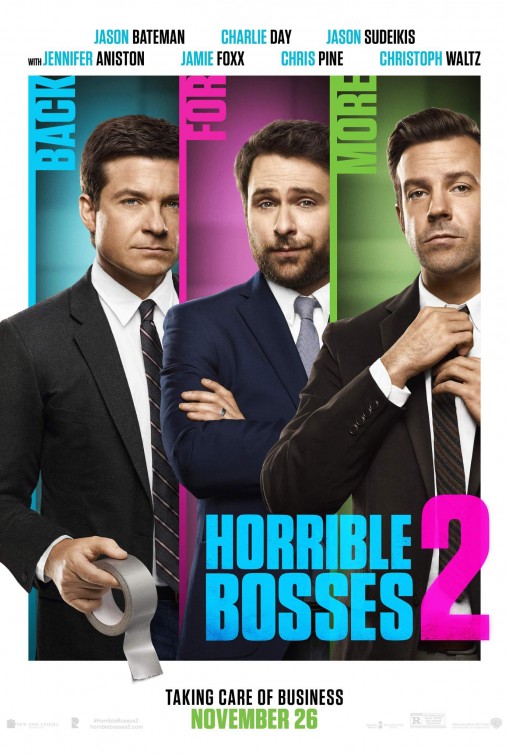
Director: Sean Anders
Cast: Jason Bateman, Jason Sudeikis, Charlie Day, Jennifer Aniston, Chris Pine, Christoph Waltz, Kevin Spacey, Jamie Foxx
The original comedy Horrible Bosses was hugely hilarious, so the question begs why spoil it with a sequel?
Especially in light of the 2008 economic recession, Hollywood has increasingly fallen prey to the sequel syndrome as a way of generating additional work for actors and more profits for the main film studios. Not every successful original comedy or action film needs to be made into a sequel. Horrible Bosses 2 and Red 2 are example of this money making cinematic phenomenon which started in the 1980’s. Think The Lethal Weapon, Rambo and Die Hard franchises.
Director Sean Anders’s Horrible Bosses 2 has very little to do with Bosses and a lot to do with three losers Dale, Kurt and Nick played with great glee by Jason Sudeikis, Charlie Day and Jason Bateman who after appearing on Good Morning Los Angeles TV show get conned into selling their shower buddy product to a wealthy but unscrupulous industrialist Bert Hanson played by Oscar Winner Christoph Waltz (Django Unchained) and his spoiled playboy son, Rex wonderfully portrayed by Chris Pine (Jack Ryan: Shadow Recruit, Star Trek).
So begins a rather lame ploy on the classic Stockholm syndrome plot as the gang of three attempt to kidnap Pine and in a rather strange twist of events gets manipulated by him into extorting a huge ransom sum for his so called release. The dialogue is not that funny, the script lazy, not to mention the appearance of highly talented Oscar Winner Kevin Spacey (The Usual Suspects), who was one of the original Horrible Bosses, is completely underutilized.

Even Jennifer Aniston (We are the Millers, The Bounty Hunter) reprisal of her role as a nymphomaniac dentist Dr Julia Harris, also one of the original Horrible Bosses does not save the blighted plot. The best scenes in the film are actually provided by Oscar Winner Jamie Foxx (Ray) as MotherF*cker Jones and of course Pine who has a field day as the manipulative kidnap victim.
This sequel is really cashing in on the success of the first film and let’s hope that Hollywood does not make a third without there being a more credible and inventive storyline. Audiences who loved the first film, might be disappointed, so save Horrible Bosses 2 for some lazy Saturday afternoon viewing.
Posted in Sean Anders |
Tags: Charlie Day, Chris Pine, Christoph Waltz, Jamie Foxx, Jason Bateman, Jason Sudeikis, Jennifer Aniston, Jonathan Banks, Kevin Spacey |
Comments Closed
War is a Constructed Image
The Hunger Games: Mockingjay Part 1

Director: Francis Lawrence
Cast: Jennifer Lawrence, Liam Hemsworth, Josh Hutcherson, Woody Harrelson, Julianne Moore, Jeffrey Wright, Elizabeth Banks, Phillip Seymour Hoffman, Natalie Dormer, Donald Sutherland, Robert Knepper, Paula Malcolmson, Sam Claflin
The final book of the Hunger Games Trilogy, Mockingjay comes to the big screen in two parts, Hunger Games: Mockingjay Part 1 is a monochromatic diatribe about notions of war as a constructed image, and intelligently explores the concept of rebellion.
Katniss Everdeen, superbly played by Oscar Winner Jennifer Lawrence (Silver Linings Playbook) has survived the Quarter Quell and plunged Panem into civil war between the Capital and the Districts, with her own District 12 being obliterated by the ruthless Capitol bombers.
Director Francis Lawrence creates a superb dichotomy between a more vicious Capital and the newly discovered District 13, a haven for the rebels built entirely below ground so as to escape the Capital’s firepower. Utilitarian District 13 ruler Madame President Coin, wonderfully played by Oscar Nominee Julianne Moore has plans of using Katniss as the much beloved symbol of resistance, the Mockingjay.

However in the Capital, President Snow, played by veteran star Donald Sutherland has captured Peeta Mellark, the tribute who didn’t escape the Quarter Quell and like Coin is using Mellark (Josh Hutcherson) in a vicious game of propaganda and deceit to lure Katniss and her supporters into attacking the Capital.
In this manipulated game of propaganda, both Katniss and Mellark are used as constructs by a ruthless war machine intent on destroying humanity in this allegorical society. With Katniss being filmed against the ruins of one of the Districts after a hospital is destroyed, the viewer would think they are watching scenes of the recent conflict in the Syrian Civil War or the Crisis in the Ukraine.
Director Lawrence obviously working with a far bigger budget, has a clearer vision of this dystopian world post Hunger Games, after the lavish excess of the Capitol and the vicious expandability of the children fighting each other in a death match which made the first two films The Hunger Games and Catching Fire that much more riveting.
Whilst in the first two, the children or tributes as they were known in Suzanne Collins novels were the centre of attention, in Mockingjay it is clearly an adult world, with war a primary signifier in moving the brutal narrative along, ably assisted by a brilliant supporting cast.
This cast includes Oscar winner Phillip Seymour Hoffman (who incidentally died of a drug overdose during the filming of Mockingjay) in one of his last screen performances as Plutarch Heavensbee, Elizabeth Banks in a wonderful cameo as the downtrodden Prisoner of War yet still irrepressible Effie Trinket, along with Woody Harrelson as Haymitch and Jeffrey Wright as Beetee who all bring a gravity to Katniss’s predicament as her decision to become the symbol of the rebellion is thwarted by President Snow’s twisted methods especially using Mellark as a pawn.
The Hunger Games and Catching Fire was clearly aimed at the mature teenage market, but Mockingjay Part One is definitely aimed at a more mature audience whose has become used to seeing violent images of global conflicts flash across their TV screens. Even though it’s an allegorical tale Mockingjay Part 1 undoubtedly reflects a contemporary 21st century immunity to violent onscreen images of war, highlighting that along with all the propaganda and the rhetoric, the constant bloodshed seen has become engrained in a future society which appears to be emotionally resistant to such global strife, despite its constant coverage on all the international news broadcasts.
Mockingjay Part 1, although the storyline purposefully is left hanging at the end, still remains an impressively dark cinematic vision, gripping and unrelenting. Audience naturally hope that Part 2 will be equally brilliant and impressive. This is recommended viewing for those that have read the books and have followed the massive success of this ferocious and fascinating film franchise.
Posted in Francis Lawrence |
Tags: Donald Sutherland, Elizabeth Banks, Jeffrey Wright, Jena Malone, Jennifer Lawrence, Josh Hutcherson, Julianne Moore, Liam Hemsworth, Mahershala Ali, Natalie Dormer, Paula Malcolmson, Philip Seymour Hoffman, Robert Knepper, Sam Claflin, Sarita Choudhury, Stanley Tucci, Woody Harrelson |
Comments Closed
The Lazarus Missions
Interstellar

Director: Christopher Nolan
Cast: Matthew McConaughey, Anne Hathaway, Jessica Chastain, Michael Caine, John Lithgow, Casey Affleck, Matt Damon, Wes Bentley, Ellen Burstyn, David Oyelowo, Topher Grace, Timothee Chalamet
Memento meets Gravity in director Christopher Nolan’s epic space opera, Interstellar, a convoluted time travel astrophysical fantasy about a NASA astronaut who gets caught up in a mission to travel to an alternative Galaxy in a bid to save the remaining humanity on earth from a dwindling supply of oxygen.

Assembling an all star cast is what director Nolan does best at insuring that his films have credibility as a blockbuster and with a range of stars, yet unlike Inception or The Prestige, his earlier films which dealt with dreams and magic, Interstellar tends to emulate the great director Stanley Kubrick’s masterpiece: 2001: A Space Odyssey, yet falls short of its celestial aspirations, by not being a touch more sinister.
In parts, Interstellar is brilliant and ambitious, wonderfully scored with atmospheric music by Hans Zimmer and incredibly shot with those signature spiralling shots that Nolan is so fond of. However, Interstellar suffers from two shortcomings, taking the films weighty significance too seriously and secondly a serious lack of editing. The first and last sections of Interstellar weighs down the brilliance and absolute clarity of the middle section.

With McConaughey fresh from his Oscar win on Dallas Buyers Club coupled with Hathaway fresh from her win in Les Miserables it seems like a perfect casting choice, but it’s flawed by its very contrivance. The part which does stand out so brilliantly is that of Murphy superbly played by the underrated Oscar nominee Jessica Chastain as Cooper’s grownup and embittered daughter who is hell bent in following in her father’s footsteps and traveling beyond the black hole to discover the reason for the earth’s imminent demise. Watch out for cameo appearances by Ellen Burstyn, Wes Bentley and David Oyelowo.
Fellow Oscar nominee Casey Affleck is also good as the stubborn yet stoical brother of Murphy in a part which is severely underwritten along with that of Oscar winner Michael Caine as Professor Brand who plays Hathaway’s enigmatic father, a scientist who masterminds the space exploration from the outset knowing that the intended consequences of such a doomed mission are dire and certainly revelatory at best.
Interstellar ‘s post-structural narrative gets more blurred, the further the astronauts travel through a celestial wormhole, around a vast system known as Gargantuan, soon realizing that their mission much like their own destiny is doomed to fail, resulting in a multitude of Lazarus missions.
The only subversive element is a rescued astronaut Mann, wonderfully played by Matt Damon, found on a frozen wasteland of a planet which seems to be the only alternative to the dust clad environment of a doomed earth, who is wily in his attempts to escape his icy predicament.
With a script by Jonathan Nolan, Interstellar suffers from too little said and not enough explained, while most of the narrative rests on some remarkably clever visual clues which only make sense in the last section of the film, which resembles a pastiche of Inception mixed with an unquantifiable mystical factor.
The cast with a threadbare script had little else to work on besides their own doomed destinies and the terrors of space. Thus there is loads of human anguish thrown in along with some stunning visuals, but at nearly three hours long Interstellar could have been expertly edited to make a more concise tale of 21st century doomed space exploration. Besides Anne Hathaway just doesn’t cut it as an astronaut and should stick to period dramas, where at least the claustrophobia is explained by historical context and not subliminal infinity.

As an avid fan of Christopher Nolan films and trust me I loved The Dark Knight Trilogy and Inception, I personally found Interstellar fascinating yet an ultimately flawed and slightly contrived piece of cinema crippled by its unendurable length, without enough plot twists to generate sufficient audience excitement. Like Inception, Interstellar will certainly be open to discussion.
Posted in Christopher Nolan |
Tags: Anne Hathaway, Casey Affleck, David Oyelowo, Ellen Burstyn, Elyes Gabel, Jessica Chastain, John Lithgow, Matt Damon, Matthew McConaughey, Michael Caine, Timothee Chalamet, Topher Grace, Wes Bentley, William Devane |
Comments Closed
Doves of the Bandit Roost
The Immigrant

Director: James Gray
Cast: Joaquin Phoenix, Marion Cotillard, Jeremy Renner, Dagmara Dominicyk, Angela Sarafyan
With glorious sepia coloured cinematography by Darius Khondji, Ellis Island and early 1920’s immigrant New York comes to life in director James Gray’s period film The Immigrant, nominated for the 2013 Palm d’Or.
Oscar Winner for La Vie en Rose, French actress Marion Cotillard, speaking both English and Polish gives a complex and nuanced performance as Catholic Polish immigrant Ewa who after arriving on Ellis Island is soon rescued by the crazed opportunistic pimp Bruno, superbly played by Joaquin Phoenix (The Master, Gladiator). The formidably and talented Joaquin Phoenix seems to be director James Gray’s cinematic partner and has starred in most of his films including The Yards, Two Lovers and We Own The Night.

Desperate to return to Ellis Island to rescue her sister Magda (played by Armenian actress Angela Sarafyan) who has been quarantined for a contagious lung infection, Ewa soon enters quite bravely into a life of prostitution and cheap vaudeville theatre orchestrated by the erratic sometimes violent Bruno.
With a confident flourish Bruno introduces Ewa to the Doves of the Bandit Roost, a sleezy peep show and late night dive spot for immigrant lowlifes. This is New York in 1921 as prohibition has just been enforced and the raunchy social dynamics has been thrust underground.

Conflicted by what she is forced to do to get money and her overwhelming desire to rescue her sister Magda, Ewa, gorgeous and enigmatic, brave and brazen gets caught between the unpredictable Bruno and his seemingly more stable cousin, a freelance illusionist Orlando, played with flourish and against type by Jeremy Renner (The Hurt Locker, The Town). Ewa first captures a glimpse of the illustrious Orlando when she is sent back to Ellis Island and becomes an unwilling witness to one of his spell bounding illusions.
Soon affection develops between Orlando and Ewa, yet their mutual admiration is constantly thwarted by the controlling and threatening Bruno, who is desperate to make money out of his group of woman who he open flaunts to paying customers under tunnels in New York’s Central park.
New York born director James Gray presents a captivating if slightly dim view of the harsh realities of immigrants which arrived in the Big Apple in their thousands following the end of the WW1 leaving a poverty stricken and ruined Europe behind, always in search of the illusive, yet treacherous American Dream.
Naturally Cotillard is ravishing and believable as Ewa and the on screen chemistry between her and Phoenix is palpable almost to the point of tragedy much like it was between Kevin Kline and Meryl Streep in the superb film Sophie’s Choice, set almost three decades later.
The Immigrant is majestically shot, evocative, moody and brilliantly acted. It’s a classic melodrama reminiscent of early Italian Neo Realist films of the late 1940’s. The ambience and production design is beautifully recreated of early 20th century New York in a narrative which highlights that the hardships facing immigrants to any new country are perennial and just as relevant now as it was almost a century.
Lovers of atmospheric melodramas focusing on a nuanced yet doomed love triangle, will enjoy The Immigrant, but for many this film will have a very limited appeal.
Posted in James Gray |
Tags: Angela Sarafyan, Dagmara Dominicyk, Jeremy Renner, Joaquin Phoenix, Marion Cotillard |
Comments Closed
The Art of Surveillance
A Most Wanted Man

Director: Anton Corbijn
Cast: Philip Seymour Hoffman, Rachel McAdams, Robin Wright, Willem Dafoe, Daniel Bruhl, Nina Hoss, Grigoriy Dobrygin, Rainer Bock
Dutch director of The American, Anton Corbijn skilfully brings to cinematic life the spymaster John le Carre’s novel A Most Wanted Man set in the German port city of Hamburg, the site in which the 9/11 terror attacks emanated from.
Oscar winner Phillip Seymour Hoffman (Capote) in one of his last onscreen performances before his untimely death in New York in 2014, plays German intelligence officer Gunther, an overweight heavy drinking, chain smoking yet patience man who engineers a web of intrigue and surveillance when a Chechen Muslim illegal immigrant arrives in Hamburg seeking asylum.
The immigrant is half Chechen and half Russian and his true reasons for arriving in Hamburg is to claim access to a private bank account held by his Russian father who stashed funds after several covert and illegal Russian/Chechen wars.

The most wanted man, Issa is a Muslim convert, played by Russian actor Grigoriy Dobrygin, who seeks shelter with a Turkish mother and son. They in turn seek advice on his precarious existence with a human rights lawyer and refugee sympathizer Annabelle Richter played against type by Rachel McAdams.
Gunther with the help of his surveillance team including Daniel Bruhl (Rush) as Maximilian and German actress Nina Hoss as Irna Frey who manipulate Annabelle into setting up a play to gain the confidence of Issa whose sudden wealth is being held by a suave German banker Tommy Brue played by Willem Dafoe (Nymphomaniac).
The German surveillance team is interested in where the funds might go, namely to a prominent Muslim businessman Abdullah in Hamburg who is funneling cash to jihadist groups in the Middle East through a shipping company based in Cyprus.
A Most Wanted Man’s opening scene focuses on the murky swirling waters of the river Elbe running through the second largest port in Europe after Rotterdam, a fitting motif for the tricky surveillance and bureaucracy involved in the gathering of intelligence on suspected terrorists post 9/11. This is an intricate geopolitical affair, with allegiances and deception as part of the cold business of espionage in the tradition of Zero Dark Thirty and Tinker Tailor Soldier Spy.
Into the play comes the seemingly sympathetic CIA officer, Martha Sullivan played by Robin Wright, last seen in the excellent series House of Cards. As Gunther increasingly manipulates both Issa and Annabelle to his own advantage without wanting a full scale extradition, the tension and strain becomes almost unbearable.
This is a well plotted gritty thriller without the flashy car chases or violent fight sequences synonymous with The Bourne Trilogy. Director Corbijn opts for a more sedated, yet carefully paced spy narrative, slow moving in parts, rather emphasizing the mental and emotional strain on all those involved especially Gunther, with his unraveling coming to a head at the film’s rather poignant unexpected conclusion.
At just over two hours, A Most Wanted Man could have been edited in parts, but is nevertheless a fascinating study of the excruciating art of surveillance. Recommended for cinema goers who enjoy well-plotted intelligent spy thrillers without the glamour or excitement of a Bond film.
Posted in Anton Corbijn |
Tags: Daniel Bruhl, Grigoriy Dobrygin, Nina Hoss, Philip Seymour Hoffman, Rachel McAdams, Rainer Bock, Robin Wright, Willem Dafoe |
Comments Closed

- Georgia’s Production Sector Shifts Gears Targeting Local Creators and Production InnovationInnovation drives the Georgia production sector — it’s adapting in the face of a production decline and increased competition from Europe. “Studios are really looking inward. They’re incorporating more vertical integration. They’re doing partnerships and acquisitions,” says Jezlan Moyet, president of Georgia Entertainment. “They’re making sure that not only do they have the infrastructure, but […]Carolehorst
- Summer Movie Season: 5 Burning Questions as Superheroes, ‘Star Wars’ and Spielberg Are Put to the TestNo pressure, but Hollywood has a lot riding on summer movie season. The busy stretch from May to August is crucial for the industry, representing 40% of the annual box office. But consumer tastes have been rapidly shifting since the pandemic, so this year’s slate should reveal a great deal about what audiences will (or […]Rebecca Rubin
- Laika Debuts Teaser Trailer for Travis Knight’s Handcrafted Fantasy ‘Wildwood’Laika has unveiled the teaser trailer for “Wildwood,” its upcoming stop-motion feature film directed by Travis Knight with a script written by Chris Butler. The film is set to open nationwide in theaters on Oct. 23, and marks the studio’s first film since 2019’s “Missing Link.” “Wildwood” is based on the book written by Colin […]Jazztangcay
- ‘Big Bang Theory’ Spinoff ‘Stuart Fails to Save the Universe’ Drops Apocalyptic First Teaser, Sets Official Release DateHBO Max unveiled the first teaser trailer for the “Big Bang Theory” spinoff “Stuart Fails to Save the Universe.” The teaser was released during the Warner Bros. Discovery upfront presentation to advertisers in New York on Monday. Series stars Kevin Sussman, Lauren Lapkus, Brian Posehn, and John Ross Bowie all took the stage to reveal […]Joseph Otterson
- Jason Priestley, Ken Jeong, Mae Martin, Tantoo Cardinal Named Rockie Awards Gala Honorees at This Year’s Banff World Media FestivalJason Priestley (“Beverly Hills 90210”), Ken Jeong (“Community”), Mae Martin (“Wayward”) and Tantoo Cardinal (“Killers of the Flower Moon”) have been selected as this year’s Rockie Awards Gala honorees at the Banff World Media Festival. In addition, the Banff World Media Festival has announced this year’s heavy hitters taking part in its Showrunner Super Panel, […]Varietyschneider
- Bella Thorne Returns to her Disney Roots With Red Hair Transformation May 13, 2026Bella Thorne’s new look will have you texting your friends TTYLXOX. After all, the Disney alum’s latest hair transformation is a total nod to her Shake It Up days, as she returned from her dark...
- How Katy Perry, Orlando Bloom and Miranda Kerr Successfully Co-Parent May 13, 2026When it comes to parenting their shared children, Katy Perry, Orlando Bloom and Miranda Kerr are never hot n cold. Instead, with Flynn—Bloom's 15-year-old son with former wife Kerr—and Daisy (his...
- Wheel of Fortune Reveals $70,000 Luxury Prize Donated by Jay Leno May 13, 2026One lucky person will be trading in the Wheel of Fortune for a steering wheel. That’s because Jay Leno is donating one of his beloved luxury cars to be gifted on the Wheel of Fortune. The former...
- Ashley Judd Shares She Threw a Birthday Party for Her 12-Year-Old Self May 13, 2026Ashley Judd is healing her inner child. When the Heat actress turned 58 in April, instead of celebrating with a classic birthday, she threw herself a playful celebration in honor of her younger...
- Old Navy x Disney's Summer Collab Delivers Americana Perfection May 13, 2026Hot dog! Old Navy and Disney's new collection is here, and it's serving stars, stripes and style. The latest collaboration just debuted at Old Navy, with summer-ready pieces for the whole family....
- Read MoreDifferent providers offer different cell phones, so take a look at the options from each provider to choose the right one for you. You may also want to look into any promotions that the providers have to offer, such as free cell phones in exchange for signing a contract. Tags: 2gmhass90